Two Plots and a Headline The 2026 Bill on Foreign Buyers
The question we are being asked every week
Some version of this arrives in our inbox most weeks now, usually from a couple in England who have been saving towards a place in Paphos for years: are they about to be banned from buying? They have read a headline about Cyprus restricting foreign ownership, they have worked out that Brexit made them non-EU, and they want to know whether to rush, wait, or give up on the idea.
The honest answer takes longer than a headline allows, so here it is in full. There is a real bill, it is back in front of parliament as of September, and it would change things. It would also change far less for an ordinary buyer than the coverage suggests, and the part that matters most to the people writing to us is not in the bill at all.
What is actually on the table
Four separate proposals have been circling since January 2026, from AKEL, from a DIKO, DISY and DIPA group, and one from DISY’s Nikos Georgiou on the mechanics of applying. The House interior committee has been trying to consolidate them into a single text. The common ground across all four looks like this.
Third-country nationals would be limited to a maximum of two plots with a combined area of 1,100 square metres, and to a single home. AKEL’s version puts a residence at up to 200 square metres, a shop at up to 200 and an office at up to 300, all without needing Cabinet approval, with anything beyond that requiring it. The government’s own working draft has not settled the residence figure; Interior Minister Constantinos Ioannou said in September that the details on size were still being hammered out.
Whole categories of land would go off limits regardless of size: agricultural and forest land, anything adjacent to the ceasefire line, and land near critical infrastructure, which in the drafting means ports, airports, military camps and the coastal zone. For companies, the test being discussed is at least 51 per cent ownership or control by EU or EEA citizens or entities, which is aimed squarely at the practice of putting a Cyprus company between a third-country buyer and the Land Registry.
Nothing here is law. The proposals were scheduled for a plenary vote in April, pulled at the last minute, and then expired when parliament dissolved. The new interior committee picked them up again on 2 September, dealt with purchases by individuals, and scheduled purchases by companies for October. That second session is the one worth watching, for reasons we will come to.
Cyprus is not currently a free-for-all
The framing in most of the coverage is that foreigners can presently buy whatever they like and that this bill would finally impose limits. That is not what the law says, and the gap matters if you are trying to work out how much is really changing.
The Acquisition of Immovable Property (Aliens) Law, Cap. 109, has restricted non-EU buyers for decades. A third-country national already needs permission to acquire property, granted under delegated authority by the District Officer rather than the Council of Ministers sitting in session, and is already limited to one property, with land capped at 4,014 square metres. EU and EEA citizens, by contrast, have bought freely since the five-year transitional period Cyprus negotiated on accession expired in 2009. They need no permit and face no cap.
So the headline change for an individual non-EU buyer is a cap moving from 4,014 square metres to 1,100, plus the new prohibited zones, plus a possible ceiling on house size. That is a real tightening. It is not the introduction of controls where none existed, and anyone writing it up that way has not read Cap. 109. The ground rules for buying here as a foreigner are set out in our guide to buying property in Cyprus as a foreigner, and they have not changed yet.
The numbers do not support the premise
Here is where we part company with the argument being made in committee, and we will put our own numbers behind it rather than just disagreeing.
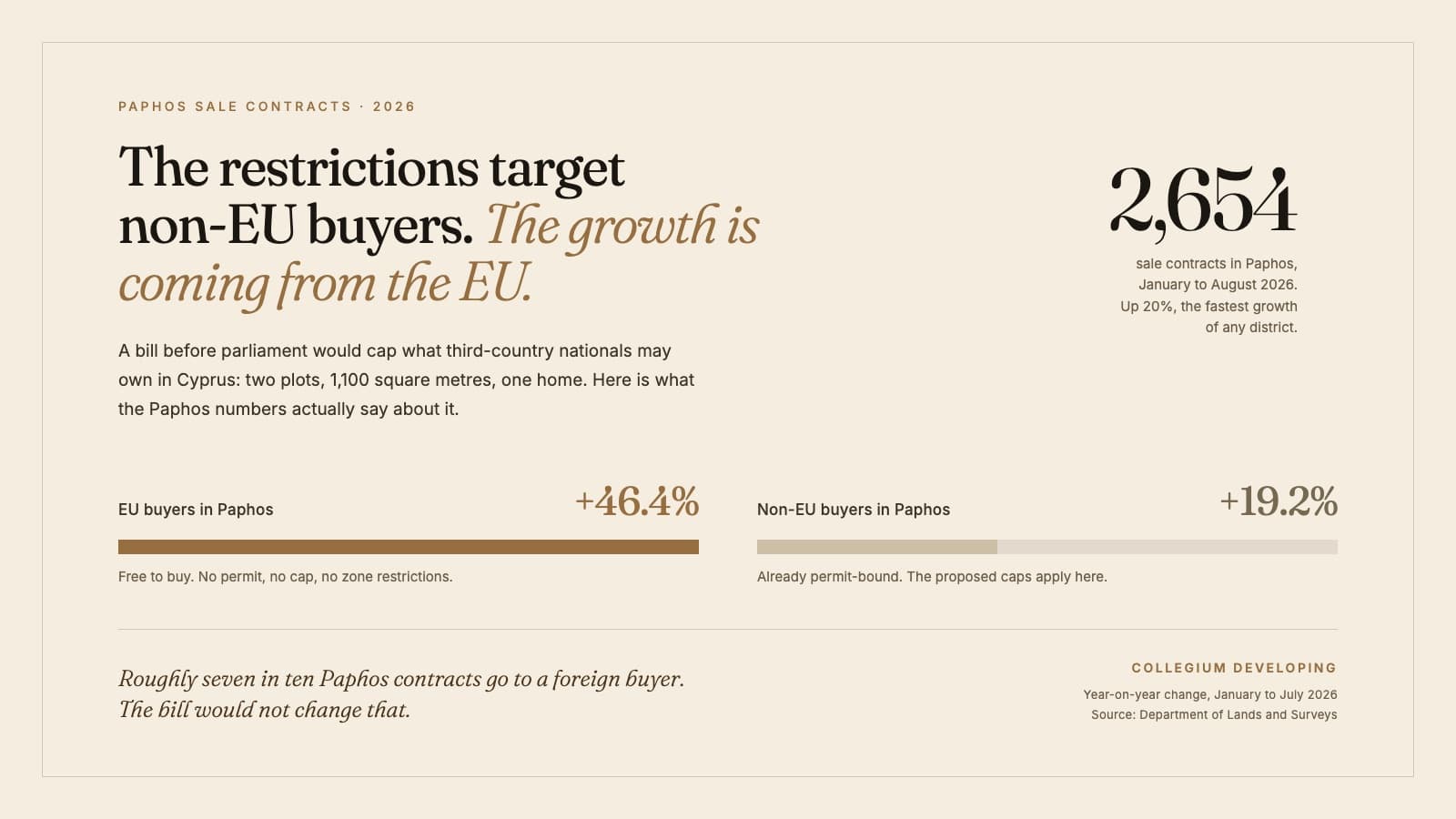
The case for restriction rests on foreign buyers taking an ever-larger share of Cyprus. The share is certainly large. Between January and July 2026, foreign buyers signed 4,980 sale contracts, 41.3 per cent of the market, up from 39.2 per cent a year earlier. Paphos is the extreme case: 1,667 of those contracts were in this district, roughly seven in ten of everything sold here. Across the first eight months Paphos recorded 2,654 contracts in total, up 20 per cent, the fastest growth of any district on the island.
Now look at who is driving it. In Paphos, purchases by EU buyers rose 46.4 per cent year on year. Purchases by non-EU buyers rose 19.2 per cent. Island-wide, non-EU buyers have fallen from 72.6 per cent of all foreign purchases in 2023 to 66.1 per cent in 2026. The non-EU share is not climbing. It is receding, and the acceleration is coming from Germans, Poles, French and other EU nationals who this bill does not touch and, under EU law, cannot touch.
Put plainly: the bill restricts the slower-growing half of foreign demand and leaves the faster-growing half alone. If the concern is that too much of Paphos is owned by people who are not from here, this legislation does not address it. It redistributes who the foreign owners are. We think that is worth saying out loud, and we have not seen anyone in the debate say it.
The limits barely touch an ordinary buyer, except one
Take the proposed caps and hold them against what people actually buy here. An apartment in Paphos is typically 85 to 140 square metres. A three-bedroom villa sits on a plot of roughly 300 to 550 square metres. Two plots totalling 1,100 square metres is, for a family buying a home rather than assembling a land bank, a generous allowance. Most of our buyers would never approach it.
The number that could bite is the 200 square metre residence figure in AKEL’s draft, and it would bite in a way that has not been discussed, because of how covered area is counted in Cyprus. A four-bedroom villa with a decent covered veranda, a carport and a basement does not stay under 200 square metres of covered area. Neither does a generous three-bedroom with the outdoor living space that is the entire point of building here. If that figure survives into the final text and is measured on total covered area rather than internal floor area, it does not stop a land banker. It stops a retired couple from Kent buying the villa they have been planning for a decade.
We would rather the drafting dealt with that now than after the first refusal. If you want to cap the size of a foreign-owned home, say whether verandas, basements and covered parking count, because in Cyprus construction those three things are most of the difference between 180 square metres and 240.
British buyers are in scope, and nobody is saying so
The rhetoric in committee is about beaches, hotels and strategic land. Aristos Damianou, who chairs the interior committee, has talked about large foreign private interests buying everything from beaches to hotels, and about land near harbours and airports. That is a coherent national security argument and we do not dismiss it.
But a law written against that problem applies to everyone in the same legal category, and since 1 January 2021 that category includes British citizens. The UK buyer who has been coming to Paphos for twenty years is, in the eyes of Cap. 109 and of this bill, a third-country national in precisely the same bracket as an offshore vehicle buying a coastal plot. Same cap, same prohibited zones, same permit.
Britain is one of the largest sources of buyers in this district, and for a great many of them Paphos is where they intend to live rather than an investment held at a distance. The debate has not distinguished between the two, and the draft does not either. If you are weighing a move, the practical picture is in moving to Cyprus from the UK, and the residency route that many buyers pair with a purchase is in Cyprus permanent residency by investment.
The real bottleneck is the district office, not the statute
This is the part we care about most, because we live with it on every sale to a non-EU buyer.
The permit a third-country national needs already exists. The problem is how long it takes to get, and the answer depends entirely on which district you buy in. As of July 2026 the application takes roughly 30 to 45 days in Limassol. In Paphos it takes four to five months. Same law, same form, same country, four times the wait. Our buyers absorb that delay with their money committed and their lives on hold, and there is no legal reason for it. It is staffing.
The bill, as drafted, adds checks to that process: stricter control mechanisms, verification of eligibility, scrutiny of beneficial ownership. Every one of those is defensible on its own terms. All of them land on the desk of the district office that is already the slowest on the island, with no provision we can find for resourcing it. We would like to see the Paphos office brought to Limassol’s turnaround time before a single new check is added to its workload. Regulation that the administration cannot execute is not regulation. It is a queue.
There is a second number pointing the same way. In the first seven months of 2026, 4,980 foreign sale contracts were signed and 2,683 transfers were completed. That is the widest gap in four years. Contracts are being signed much faster than the system converts them into registered ownership, which is the same backlog problem we wrote about in Cyprus title deeds in Paphos, seen from the other end.
The company route is the actual loophole
If you want to know which part of this bill will genuinely change behaviour, it is the part being discussed in October, not the part that made the headlines in March.
Cap. 109 restricts aliens. It has historically been far less effective against a Cyprus-registered or EU-registered company whose beneficial owners are third-country nationals, because the company is not an alien. That route is how a good deal of large-scale acquisition has happened without anyone applying for a permit, and it is what the auditor-general flagged in 2025 when reporting that foreign nationals accounted for over a quarter of 2024 sales, a figure the office itself expected to undercount corporate purchases.
A 51 per cent EU ownership and control test would close it. We think it should be closed, and we say that as a developer who sells to third-country nationals regularly. A rule that binds the retired couple buying one apartment and not the vehicle buying forty is not a rule, and it brings the whole framework into disrepute. If you have been advised at any point to buy through a Cyprus company specifically to avoid the permit, treat that advice as having a short remaining shelf life, and take proper legal advice before restructuring anything.
What we would do if you are buying in Paphos now
Do not rush on account of this. There is no announced cut-off date, no published transitional provision, and no draft in circulation that says contracts signed before a given date are protected. A bill that has already been deferred once and died once is not a deadline, and a purchase made in a panic is a worse decision than a purchase delayed by six months.
Do get your permit application in early rather than treating it as end-of-process paperwork. In Paphos it is the long pole in the whole transaction, and the sooner the file is with the district office the sooner the clock starts.
Do lodge your contract of sale at the Land Registry within the statutory period. Specific performance protects your position whatever happens to this legislation, and it is the single most important thing a non-EU buyer does. If you are buying before completion, the mechanics are in buying off-plan property in Paphos.
Do ask the developer for the plot area and the total covered area in writing, in square metres, before you sign. Two numbers. If a size cap arrives, those are the two numbers that decide whether your purchase sits inside it, and a developer who cannot produce them quickly is telling you something else as well. We make that argument for other reasons in choosing a property developer in Paphos.
And if you were considering land rather than a finished home, think harder about it than you would have done a year ago. Land is where the caps and the prohibited zones have real force, agricultural plots look likely to be excluded outright for third-country nationals, and the margin for error has narrowed. The groundwork is in buying land in Cyprus, and where the district’s zones sit is in the best areas to buy property in Paphos.
Where we come out on it
We are a Paphos developer and a large share of what we build is bought by people who are not Cypriot. You would expect us to oppose this, and on the company test we do not. Close it. On the zones near the ceasefire line and critical infrastructure, we have no argument either; a country in Cyprus’s position is entitled to decide who owns the land next to its ports.
What we object to is a size cap set without saying how it is measured, in a district where the existing permit already takes five months, justified by a trend the Land Registry’s own figures show is going the other way. The people it will actually inconvenience are not the ones the speeches are about. They are the couple who have been coming to Coral Bay since their children were small.
Watch the October committee session on corporate purchases. That is where this bill either becomes a serious piece of law or stays a gesture aimed at the easiest target. For the wider context of what is happening to prices and supply here while all this is debated, see the Paphos property market in 2026.
This is a bill, not an act. Everything above describes proposals that may change substantially or never pass at all, and none of it is legal advice. Check your own position with a Cyprus lawyer before you act on any of it.
Not sure where this leaves you?
Tell us your nationality and what you are hoping to buy, and we will tell you straight how the current rules apply to you, how long the Paphos permit is really taking, and whether anything on the table would change it.