Planning by Exception Cyprus Rewrites the Deviation Rules
The sentence that should make you ask a second question
Somewhere in Cyprus this week, a plot is being sold with a sentence attached to it. The sentence is some version of “there is scope for a deviation here”, and it is usually delivered with a small shrug that is meant to suggest the matter is routine. Occasionally it is. Far more often it is a hope, priced into the land as though it were a fact, and the person paying for it has no idea that what is being described is an application to the Council of Ministers.
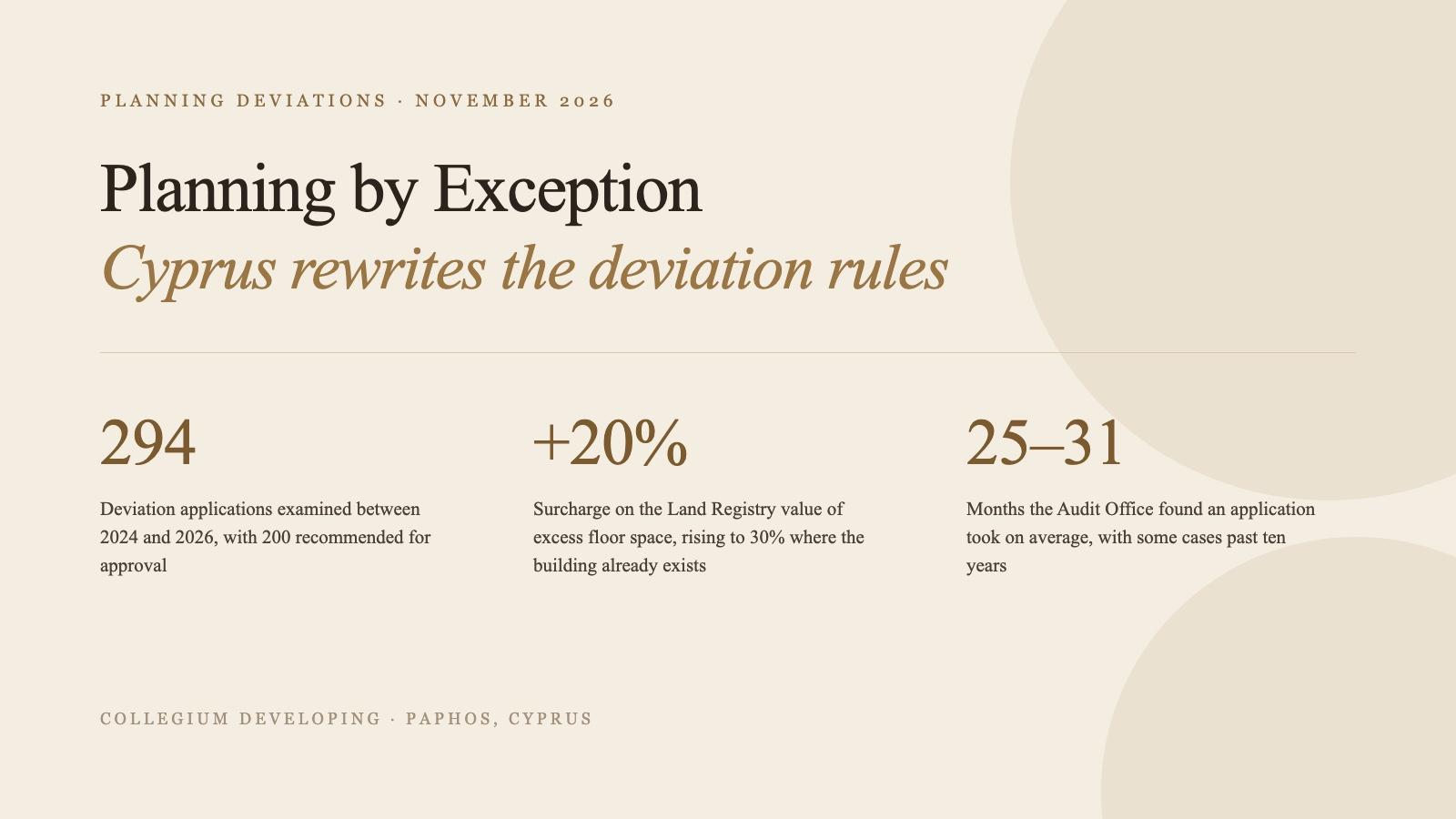
On 16 November the Interior Ministry put its reform of that process into the open. It is replacing the regulations that govern the Council for the Study of Deviations, known by its Greek initials as SYMEPA, which have been running since 1999 with one amendment in 2005. The headline change, and the one with a number attached, is that exceeding the building coefficient will now be paid for: Land Registry value of the extra floor space plus 20 per cent, rising to 30 per cent where the building has already gone up without permission, payable before you may even apply for a building permit.
We have been through this process. We have also walked away from plots because the deviation the seller was confident about was not one we would have got, and we have watched other people buy those same plots. So this is worth writing down properly, because almost nothing accurate about it exists in English, and because the reform is both better than what it replaces and, in our view, still too timid in the one place it mattered most.
What a deviation actually is
Cyprus plans development through Local Plans and the Policy Statement for the Countryside. Those documents divide the island into zones and give each zone a building coefficient, a coverage figure, a number of storeys and a height. If you have not met those four numbers before, we set out how they work and what they do to a plot in planning zones in Paphos. Between them they decide what your land is worth, which is why people spend so much energy trying to get around them.
Article 26 of the Town and Country Planning Law of 1972 is the way around them. It allows the Council of Ministers to grant a planning permit that departs from the Development Plan in cases that are exceptional and justified in the public interest. SYMEPA is the body that studies those applications and sends a reasoned recommendation up through the Interior Minister. It does not decide anything. The Council of Ministers decides, and it is free to disagree.
Two things follow from that structure, and both matter to anybody buying land. The first is that a deviation is not a planning decision in the ordinary sense. It is a political decision taken on planning advice, which is a different animal with different risks. The second is that nobody can promise you one. A planning consultant can tell you an application is arguable. An estate agent telling you a deviation is “no problem” is telling you about the inside of their own head.
The phrase to hold on to is “exceptional”. The whole architecture assumes deviations are rare. Whether they have stayed rare is the question the last two years have been quietly asking.
The numbers that forced the issue
In October 2026 the Audit Office published a special report on planning permits granted by deviation, and it is not a comfortable document. Over 2020 to 2023 it counted 633 applications examined. Of those, 259 concerned individual houses, and 139 of those houses were approved. SYMEPA departed from the recommendation of the Planning Authority in 90 of 627 cases, which is 14.35 per cent overall and rose to 21.4 per cent in 2023.
The timing figures are worse than the approval figures. The Audit Office put average processing at 25 to 31 months. Some cases ran past a decade: an application for a tertiary college filed in 2010 reached SYMEPA in 2021, and the permit issued in December 2023. The report found no justification for the delay in submitting the planning report on that file and noted that there is no unified system for tracking where an application has got to. Anybody who has had a file in that queue will recognise the description. You are not waiting for a decision. You are waiting to find out who is currently holding the paper.
Then there is the money. The report found compensation being imposed with no visible method. Some house cases attracted a payment of five thousand euro. Comparable cases attracted nothing at all. A hotel change of use was assessed at seventy thousand with no clear basis given. And it raised a structural point about independence that is worth repeating precisely because it was not an accusation against anybody: the Council of Ministers appoints SYMEPA members, can renew their terms, and can send a case back for re-examination. The report found no evidence of actual conflicts, but it found that the procedures for declaring them were missing.
The most awkward finding is the one about buildings that already exist. The Audit Office documented developments put up without permission and approved afterwards, including against negative recommendations from the planning authorities. A supermarket operating without permission in a Larnaca industrial zone received a four-year temporary permit after applications had been rejected in 2012 and 2014. A house built illegally on high-quality agricultural land in Famagusta was approved over objections. That is the part of the system the reform has to answer, because a deviation route that can be reached by building first and applying later is not an exceptions procedure. It is an amnesty with a waiting room.
What the draft regulations actually say
The draft went out for public consultation on 8 June 2026 and closed on 31 July. We will come back to that timing, because we have opinions about it. The text runs to thirty-odd regulations and three annexes, and four of them carry almost all the weight.
Regulation 21: a price on the building coefficient
This is the one that will change behaviour. Where a permit allows building beyond the permitted coefficient, the excess has to be offset in one of three ways. You can transfer coefficient from another plot, which is normally ceded to the state. You can transfer it from a listed building. Or you can pay, and the payment is the land value of the excess as estimated by the Director of the Land Registry, increased by 20 per cent, into a special fund held by the local authority and spent on works in the surrounding area.
Where the deviation is being used to regularise development that already exists, the uplift is 30 per cent rather than 20. The payment has to be made before a building permit application is submitted, which closes the gap that previously let a figure sit unpaid while the project moved on.
A donor plot, if you go that route, has to be inside the development boundary, close to the proposed development, and suitable for public open space such as a park, a square, a pedestrian street, a playground or parking. If ceding it is not practical, the coefficient can still transfer provided the corresponding land area is legally reserved.
There are exemptions, and they are sensibly drawn. Small residential buildings of up to four units for the owner or their children, each under 200 square metres, are out. So are small industrial, agricultural and livestock units within set limits, listed and traditional buildings, small local businesses up to 130 square metres, and developments serving charitable or non-profit purposes. The exemptions do not apply to unauthorised development caught by the 30 per cent rule, which is the right way round.
Minor excess can still be allowed without any offset where it improves functionality, safety, appearance or living conditions. That carve-out is necessary and it is also the loosest sentence in the draft.
Regulation 20: compensatory measures
Separately from the coefficient, a deviation can come with obligations attached. The draft lists road network improvements and associated infrastructure, expanded public green space and organised parks, public parking, community facilities and services, and upgrades to the quality of the development itself. The works are normally in the surrounding area, and in special cases elsewhere if the area is demonstrably affected.
For those categories the applicant may either build the works or pay the estimated construction cost into the local authority’s special fund, to be used only for the corresponding works. The coefficient payment under Regulation 21 is not covered by that choice. The stated aims include restoring planned densities in the wider area, replacing natural resources affected, and securing the infrastructure the surrounding area needs.
The draft text we read does not set out a calculation method for compensatory measures beyond the phrase “estimated construction cost”, and it does not name who decides which measures are imposed. Given that an inconsistent and unexplained compensation practice is exactly what the Audit Office criticised, that gap is the thing we would most like to see filled before the regulations are laid.
Regulation 19: seventeen criteria and one hard limit
The draft sets out seventeen principles against which a recommendation or decision has to be justified. They cover international treaty obligations, projects of national or regional importance, government policy adopted after the current Development Plan was published, regional development and broadening the local economic base, upgrading and diversifying the tourism product, adapting to site characteristics the plan could not anticipate, improving family living conditions without substantially increasing intensity of use, health, education, culture, research, social infrastructure, sport and public recreation, accessibility and basic infrastructure, organised and integrated development, social and affordable housing, aesthetics, natural and cultural heritage, rational development of a plot that is objectively awkward because of its size or shape, sustainable and balanced spatial development that could not have been foreseen, and resolving specific development problems.
That is a long list and a lawyer could get a lot of things through it. The limit that matters sits underneath: no deviation permit may be granted for development that substantially affects the General Development Strategy of the current Development Plan, and if the Council judges that it does, it must recommend rejection. There is also a feedback mechanism we like a great deal. Where repeated favourable decisions on similar subject matter point to a trend, the Council has to tell the Planning Council, which then decides whether the Development Plan itself should be amended through the proper procedure.
That last paragraph is the quiet admission in the whole document. If the same deviation keeps being granted, the plan is wrong and the plan should change. Everything else is housekeeping.
Procedure: notice, hearings and a deadline that bites
For certain categories of development, a notice now has to be posted on the site for 15 days, neighbours informed, and views invited. Public hearings stay mandatory for certain categories, but SYMEPA may waive one where a hearing has already been held for the same development and circumstances have not materially changed, or where affected residents were informed and nobody objected. The Council can still call a hearing whenever it wants one.
The regulations name which departments and organisations the Planning Authority must consult, specify what the reports have to contain, and set timelines. An approved deviation can be extended by up to a year where the delay was outside the applicant’s control, including slow responses from public authorities, which is an unusually honest piece of drafting. Substantial and non-substantial amendments are now distinguished, so a minor change can be handled by the Planning Authority instead of going back to the Council of Ministers.
And the Planning Authority or the Council may simply stop considering an application if the applicant does not produce the documents, plans or studies that were asked for within a reasonable time. That is aimed squarely at the files that sat for a decade. Some of those files sat because the applicant had gone quiet, and there was no mechanism to close them.
What this means if you are buying
Most people reading this are not applying for a deviation. They are buying a plot, a house or an apartment where somebody else already did, or says they will. Four things change for you.
A deviation in prospect is not value. If a plot is priced on floor space that the zone does not currently permit, you are paying today for a decision of the Council of Ministers that has not been taken. Ask whether an application has been filed, when, and what the Planning Authority has said about it. If the answer is that it has not been filed, you are buying the zone, not the pitch. We go through the rest of what to check before committing to land in buying land in Cyprus.
Extra floor space now has an invoice. If a scheme you are buying into depends on exceeding the coefficient, there is a Land Registry valuation plus 20 per cent sitting in front of the building permit. Ask who is paying it and whether it is in the budget you were shown. A developer who has not priced it has not finished pricing the project.
Existing buildings carry the higher rate. The 30 per cent uplift is aimed at development that went up first. If you are buying something that needs regularising, that gap between 20 and 30 is now a visible number on your side of the table. This sits next to the wider question of whether title can issue at all, which we worked through in title deeds in Paphos.
The timeline is still the timeline. Nothing in these regulations makes a deviation quick. The new rules should stop files dying in a drawer, and they will probably pull the average in from the high twenties in months. They will not turn a deviation into something you can build a delivery date around. Treat a project whose viability depends on one the way you would treat any other dependency on a public body, which is to say with the same caution we described in why EAC connections are holding up new homes. Asking a developer how a dependency like that is being managed is one of the better tests of whether they know their own project, and it belongs with the other checks in choosing a property developer in Paphos.
Where we come out on it
We think the reform is right in principle and short in three places, and we will say so even though two of our three objections would cost us money.
Start with what is good, because it genuinely is. Putting a published price on extra floor space is the single most useful thing the Ministry could have done. Under the old practice, the value of a deviation went almost entirely to whoever held the land, and the cost of it, in traffic, in parking, in the density of the street, went to the neighbours. Making the applicant pay the Land Registry value of what they are being given, with the money ring fenced for works in the surrounding area, converts an argument about favours into an arithmetic problem. We would rather compete on arithmetic. Between 2024 and 2026 the compensation already generated 3.4 million euro for the Cyprus Land Development Corporation towards affordable housing, which is a real number attached to a real shortage, and it sits alongside the schemes we covered in Cyprus housing schemes.
Now the objections. First, 20 per cent is too low, and we say that as people who will pay it. If you are granted the right to build floor space the zone does not allow, the market value of that right is not the raw land value of the excess plus a fifth. On any plot worth developing it is a multiple of that, because the floor space sells at built prices in a market where supply is constrained by exactly the rules being waived. A developer looking at that arithmetic will conclude, correctly, that applying is cheap. Price something below its value and you will get more applications, not fewer, which is the opposite of what an exceptions procedure is for. We would rather see the payment indexed to the value of the permitted floor space than to the land underneath it.
Second, the 30 per cent rate for existing unauthorised development is the wrong shape. A ten point premium says that building first and asking later is a slightly more expensive route to the same place. It should not be a route at all, or where the public interest genuinely requires one, it should cost enough that no rational person plans around it. The Audit Office found permits issued over negative recommendations for buildings that were already up. A surcharge does not fix that. A presumption of refusal would, with the burden squarely on the applicant to show why demolition is not the answer.
Third, and this is the one that irritates us most, look at the consultation dates. The draft was published on 8 June and closed on 31 July 2026. That is a Cyprus summer. It is the period when the industry is on site in forty degrees trying to finish before August and the professional bodies are at half staff. A reform that rewrites how extra floor space is priced across the whole island deserved an autumn window and a roadshow through the District Organisations, not eight weeks that ended before most of the people it affects had read it. We only found it because we went looking after the announcement in November. If you are a small developer or a landowner in Paphos, the consultation on the rules that will price your plot has already closed and nobody told you it was open.
Underneath all of it sits the thing neither the reform nor the Audit Office quite says out loud. A deviations procedure that handles 294 applications in two years and recommends approval of 200 of them is not an exceptions desk. It is a second planning system, running in parallel to the first, with different rules and a different decision maker. The honest fix is the one tucked into Regulation 19: when the same deviation keeps being granted, amend the Development Plan. Paphos is redrawing its Local Plan right now. Every category of deviation that has been granted repeatedly over the last decade is evidence about where the current plan is wrong, and that evidence should be going into the new plan rather than into a queue of individual applications to the Council of Ministers.
We build inside the zone. Nearly everything we have put up in Paphos sits within the coefficient we were given, and we have priced plots on that basis and lost them to people who priced on something more optimistic. We are not against the deviation procedure, which exists for good reasons and occasionally produces a better building than the plan would have allowed. We are against a market where the serious money is made by guessing what the Council of Ministers will do. Putting a price on it is the first honest step anyone has taken towards fixing that. The price just needs to be the right one.
This article describes a draft at consultation stage and public reporting available in mid-November 2026, principally the Interior Ministry announcement of 16 November 2026, the draft Town Planning and Spatial Planning (Deviations) Regulations of 2026 published on the government consultation portal, and Audit Office special report EE-EY 30/2026. The draft may change before it is laid, and figures quoted here are indicative rather than final. This is not legal or planning advice. Confirm the current position for your own plot with the Department of Town Planning and Housing and the Paphos District Local Government Organisation, and take independent legal and planning advice before you buy land on the strength of a deviation that has not been granted.
Been told your plot has scope for a deviation?
Send us the plot number and what you have been promised, and we will tell you what the zone currently allows, whether the deviation being described is the kind that gets granted, and what it would now cost to buy the extra floor space. No obligation and no sales pitch.