Finished and Dark Why EAC Connections Are Holding Up New Homes in Paphos
The worst phone call in this job
There is a conversation in development work that nobody warns you about, and it is not the one about money. It is the one where a house is finished, the keys are cut, the snagging list is down to a cupboard door, and you have to tell the people who own it that they cannot move in because there is no electricity, and that you do not know when there will be. You cannot give them a date. You cannot give them a reason that sounds like a reason. They have usually given notice on a rental or sold a house in England on the strength of a delivery date, and the thing standing between them and their own living room is a queue inside a utility they have never spoken to.
On 4 November the Cyprus Mail ran a piece by the advocate Eleni Philippou under the headline “Finished, but not deliverable: homes without electricity”. It named Paphos specifically, and it described a building whose connection application went in during 2024, whose buyers were due to move in at the end of November 2026, and where by the middle of October the Electricity Authority had not started the work. We read it twice. Not because any of it surprised us, but because somebody had finally written down in public what every developer on this side of the island says privately and almost nobody says on the record, for the sensible reason that annoying the Electricity Authority of Cyprus is not a strategy for getting connected faster.
So let us say it on the record, since we are not quoting anyone and we have no connection pending that we are afraid of losing. The electricity connection is now the single least predictable item in a residential build in Paphos. Not the permit. Not the concrete price. Not the labour. The electricity. And because almost nothing has been published in English about how the process actually runs, buyers sign contracts with delivery dates in them without having the faintest idea that this risk exists.
Two completely different jobs with the same name
Ask around and you will be told that getting power connected in Cyprus takes four to eight weeks, that the deposit is a hundred or two, and that a new meter costs something north of €350. Every part of that is true, and for a new house on a new network it is close to useless. It describes a different job that happens to share a name.
Case one is a supply that can be taken from the network already in the street. The cable is there, the transformer has capacity, and what you need is a meter, an account and an inspection. That is the four to eight week job, and when people tell you connection in Cyprus is straightforward, this is what they have personally experienced, usually when moving into an existing flat.
Case two is a development that needs network built to reach it. Somebody has to design the extension, acquire the rights to run it over whatever land sits in the way, order the equipment, build it and inspect it. That is not an administrative task, it is a civil engineering project with a planning component, and it is measured in years. A buyer looking at a plot on the edge of Tala or Tsada or Kissonerga is very often in case two without knowing that case two exists.
The honest version of the question “how long does connection take” is therefore a question back: is there network at the boundary of this plot already, and has anyone checked, or are we guessing from the fact that the neighbours have lights?
The timeline, stage by stage
Here is the sequence for case two as developers describe it, with the durations currently being quoted. We have set it out in full because we have never seen it published anywhere a buyer would look, and because the total at the bottom is the number that matters.
Views from the Authority while the land is being divided: four to six months. Before plots exist on paper, the Authority is asked where it wants substations, easements and cable routes. Get this wrong and you design a scheme that cannot be powered.
The studies department: eight to ten months. This is the design of the network extension itself. It is also the bottleneck that poisons everything downstream, because nothing later in the chain can start before it finishes.
Neighbours’ consents: one to two months, or indefinitely.If the cable crosses somebody else’s land, that somebody has to agree. When the owner is traceable and reasonable this is a formality. When the owner is a 1960s estate split between eleven heirs, four of whom are in London and one of whom is dead, it is not a formality and there is no timetable for it at all.
Formal terms: around two months after the building permit exists. Note the dependency. The Authority will not issue terms until the building permit is in hand, which means the whole of the electricity process is sitting behind the whole of the permit process. We wrote about what that costs and how long it takes in building permit fees in Cyprus 2026, and the two queues stack rather than overlap.
Building the network: eight to ten months. Here is the detail that explains most of the problem. There is reportedly one external contractor per district available for this work. One. In a district where building permits across Cyprus rose 29.5 per cent in the first half of 2026, to 4,401 authorisations, led by apartment blocks.
Final inspection: around a further month. Assuming an inspector is free.
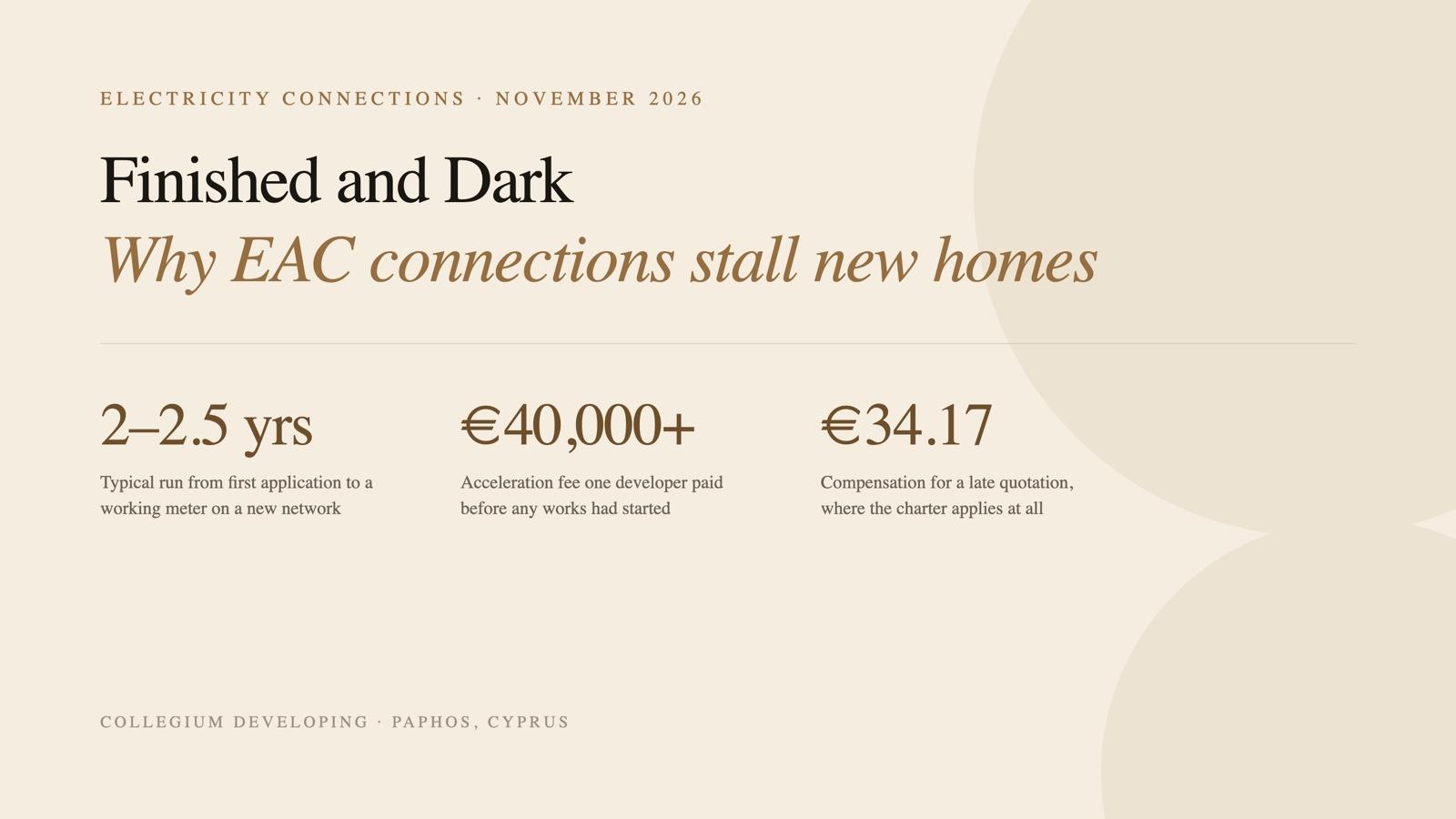
Add it up and you are at roughly two to two and a half years from the first application to a working meter. That is not a worst case and it is not a horror story collected from a forum. It is the normal run of the process, described by people who do it for a living, in a year when the market has never been busier.
What the acceleration fee actually buys
There is a paid route. A developer can pay an acceleration fee for work to be done outside normal hours, and on paper it is transformative: the studies drop to something like a month and the network build to two or three. We have used it. Most serious developers here have used it, and we think most will keep using it, because a few tens of thousands of euros against a year of a buyer’s life is not a close call.
What has changed in 2026 is that paying no longer reliably buys speed. The Cyprus Mail piece records a developer who paid over €40,000 more than two months before the article and still had no works started, with connection expected roughly two months after a start that had not happened, leaving the buyers looking at four to five months of waiting in a finished building. The answer coming back to developers who pay is that staff are short or materials are short. That is probably true. It is also an admission that the acceleration fee has stopped being a priority mechanism and become a surcharge.
We want to be fair about the pressure the Authority is under, because it is real and it is not of its own making. Demand on this island hit an all-time peak of 1,372 megawatts at a quarter to three in the afternoon on 23 July this year, against roughly 1,251 megawatts of available conventional capacity in August, with rolling outages when units at Dhekelia and Vasilikos failed. The same organisation warned back in November 2025 that an unprecedented surge in photovoltaic applications was delaying installations, which we covered when the rules changed in solar panels in Cyprus 2026. An organisation fighting to keep the lights on in a heatwave, rebuild ageing plant, absorb a solar boom and connect a record construction pipeline is an organisation that was going to drop something. It dropped new connections, because new connections are the only part of the job where the people who suffer have no leverage and no vote in the matter.
The missing party
Now the part that turns an infrastructure problem into a legal one, and it is worth understanding before you sign anything.
Your contract is between you and the developer. It names a delivery date and it almost certainly sets a penalty if the developer is late. The body actually causing the delay is not a party to it, has no obligation under it and cannot be sued on it. So the buyer claims the penalty from the developer, and the developer says the Authority’s delay was force majeure, and both of them are arguing about who absorbs a loss that neither of them caused.
Two things to know about that argument. First, as Philippou points out, Cyprus law has no general doctrine of force majeure. There is no background rule that excuses performance when something unforeseeable intervenes. It lives or dies on the wording of the clause you signed. If the clause expressly covers delay by a public authority or utility provider, the developer is probably covered. If it waves vaguely at “events beyond the developer’s control”, it is arguable, which is a polite way of saying it is expensive and slow to find out.
Second, the Authority’s own customer charter is thinner than it looks. It promises a quotation within 30 working days and pays €34.17 in compensation when it misses. Read the scope and that commitment applies where supply can be taken from the existing network. New networks, the case that generates all the misery, sit outside it. So the one published service standard in the whole chain does not cover the part of the chain that fails, and the compensation for failing is a figure you would spend on lunch.
Which is why the sensible move is to deal with this in the contract before it becomes a dispute, and why we put connection risk alongside the other things we tell people to look for in buying off-plan property in Paphos. Off-plan is where the exposure sits: 1,956 off-plan sales were recorded across Cyprus in the third quarter of 2026, up 49 per cent, every one of them with a delivery date written into it.
And now the water is doing it too
The electricity story has a twin that gets less attention. Since the 2024 local government reform, water supply sits with the district local government organisations, which inherited the backlogs and the ageing networks along with the responsibility. Water meter approvals for new houses that used to come through in days are now taking months in some districts, Paphos among them.
A house with no water is as undeliverable as a house with no power, and the two delays do not politely queue up behind each other. They run in parallel and you are held hostage by the slower one. Paphos is also the district with the tightest water position on the island, which we went through in the Cyprus water shortage, so the same reorganised body is being asked to connect record numbers of new homes while rationing what it already supplies.
The pattern is the same in both cases. A record construction pipeline is being pushed through utility processes that were sized for a quieter decade, and the cost of the mismatch lands on whoever is last in the chain, which is always the family with the mortgage and the moving van.
What we actually do about it
We cannot fix the Authority’s staffing, so what follows is simply how we try to stop this landing on a buyer as a surprise. It is not clever and it is not proprietary. It is mostly a refusal to leave the question for later.
We establish which case a plot is in before we commit to it. Is there network at the boundary, does the transformer have headroom, and if not, whose land does the extension cross. A plot that is cheap because it is slightly beyond the network is not cheap, it is an eighteen month option on a problem. We would rather pay more for a site that can be powered.
We file the Authority’s process in parallel with everything else rather than at the end. The temptation is to treat connection as a finishing trade, something you sort out when the plaster is dry. Treated that way it becomes the critical path, and the building sits there costing money while a design sits in a queue.
We give buyers a delivery date for the building and a separate, honest statement about connection, including the possibility that the two do not coincide. People can plan around bad news. They cannot plan around a confident date that turns out to be a guess, and the damage a missed date does to a relationship is out of all proportion to the weeks involved.
We check the certificate of final approval position early, because connection sits inside the wider compliance picture that also governs whether title can issue. If you have not been through that machinery, it is in title deeds in Paphos, and the lesson is the same one: the paperwork that nobody wants to think about during construction is the paperwork that decides whether you can use what you have paid for.
And we pay the acceleration fee. Even in a year when it is not buying what it used to buy, the arithmetic still works. The alternative is asking a family to rent for another winter.
Four questions to ask before you sign
If you are buying a new home in Paphos this year, these are the questions we would want asked of us, and the answers are a decent test of whether the person opposite you knows their own project.
Has the electricity application been filed, and when? Ask for the date. A development due for delivery next summer whose application went in this autumn is telling you something, whatever the brochure says. A developer who cannot produce the date has not been managing it.
Existing network or new network? If the answer is new network, ask which stage it has reached: views, studies, consents, terms, construction, inspection. Somebody who has been doing the work can name the stage without looking it up.
Has the acceleration fee been paid, and what did it change? This separates developers who are managing the process from developers who filed a form and started hoping.
What exactly does the delay clause say? Not what the salesperson says it means. Have your own lawyer read whether delay by a public authority or utility is expressly carved out, what the penalty is, when it starts running and what happens if the building is complete but unusable. Getting an answer on that last point before signing is worth more than any amount of negotiating on price. We go through the rest of the checks worth making in choosing a property developer in Paphos.
Where we come out on it
Our view, and we hold it fairly strongly: the word force majeure is doing a lot of work here that it has not earned, and it is letting everybody off the hook.
Force majeure is for the unforeseeable. A connection backlog is not unforeseeable. It is the arithmetic of one external contractor per district against 4,401 building permits in six months, a 49 per cent jump in off-plan sales, a record 1,681 sale contracts in September alone and a solar boom that was flagged in public a year ago. Every one of those numbers was published. None of them arrived overnight. A shortage you can calculate in advance is a capacity decision, not an act of God, and dressing it as an act of God removes the one thing that might fix it, which is somebody being accountable for the date.
We also think the remedy is unglamorous and small. Philippou’s list is right and no new legislation is needed for any of it: publish committed timeframes for each stage including new networks, so that a delay can be attributed to a named step rather than to fate; bring in more than one external contractor per district; hire enough engineers to clear the studies queue, because everything downstream inherits that delay; and put on enough inspectors that a finished network does not wait a month to be looked at. That is a staffing and procurement problem with a price on it, and the price is far smaller than the cost already being carried by households paying rent and a mortgage at the same time.
We would go one step further, and we accept this cuts against our own interest. We think developers should be required to disclose the electricity and water connection status in writing at the point of sale, in plain language, stage by stage. Not because most developers are hiding it, but because the ones who are not managing it properly should have nowhere to hide, and right now the market cannot tell the difference between a developer who filed in 2024 and one who will file after the roof goes on. Disclosure would separate them, and we would rather compete in a market where it does.
Until something changes, treat the question “when will it be connected” as one of the first things you ask about a new home in Cyprus rather than one of the last. The building is the easy part. We can put up a house in Paphos to a standard we are proud of and hand it over on a date we chose. What we cannot do, and what no developer here can honestly promise you, is turn the lights on by ourselves.
The timeframes, fees and charter figures described here come from public reporting and industry accounts available in early November 2026, principally the Cyprus Mail legal column of 4 November 2026, and they are indicative rather than official. Stage durations vary considerably by site and district. This is not legal advice. Confirm the current position for your own development with the Electricity Authority of Cyprus and the Paphos District Local Government Organisation, and have any delay or force majeure clause reviewed by your own independent lawyer before you sign.
Want a straight answer on connection?
Tell us the development or the plot you are looking at and we will tell you what we would check before committing, what stage an application like that should be at by now, and which questions to put to the seller in writing. No obligation and no sales pitch.