What a Permit Actually Costs Building Permit Fees in Cyprus After the October 2026 Reform
The cheapest line on the invoice
A man who had bought a plot above Tala rang us in the spring and asked a question we get perhaps twice a month. He had his architect’s drawings, he had a quote from a contractor, and he wanted to know what the building permit itself was going to cost him. Not the architect. Not the structural engineer. The fee paid to the district for the piece of paper. He had asked three people and been given three different answers, all of them vague, and the closest thing to a number was “a couple of thousand, maybe”.
We could not give him a straight answer either, and that bothered us more than it bothered him. The fee was calculable in theory. In practice it ran through a tiered schedule that stepped up with floor area, got multiplied by a cost coefficient that depended on which of three geographical bands your plot sat in, and then had extras bolted on for the boundary wall, the uncovered terraces and the parking. Nobody outside the district office could work it out in advance with any confidence, and the people inside the district office did not especially enjoy working it out either.
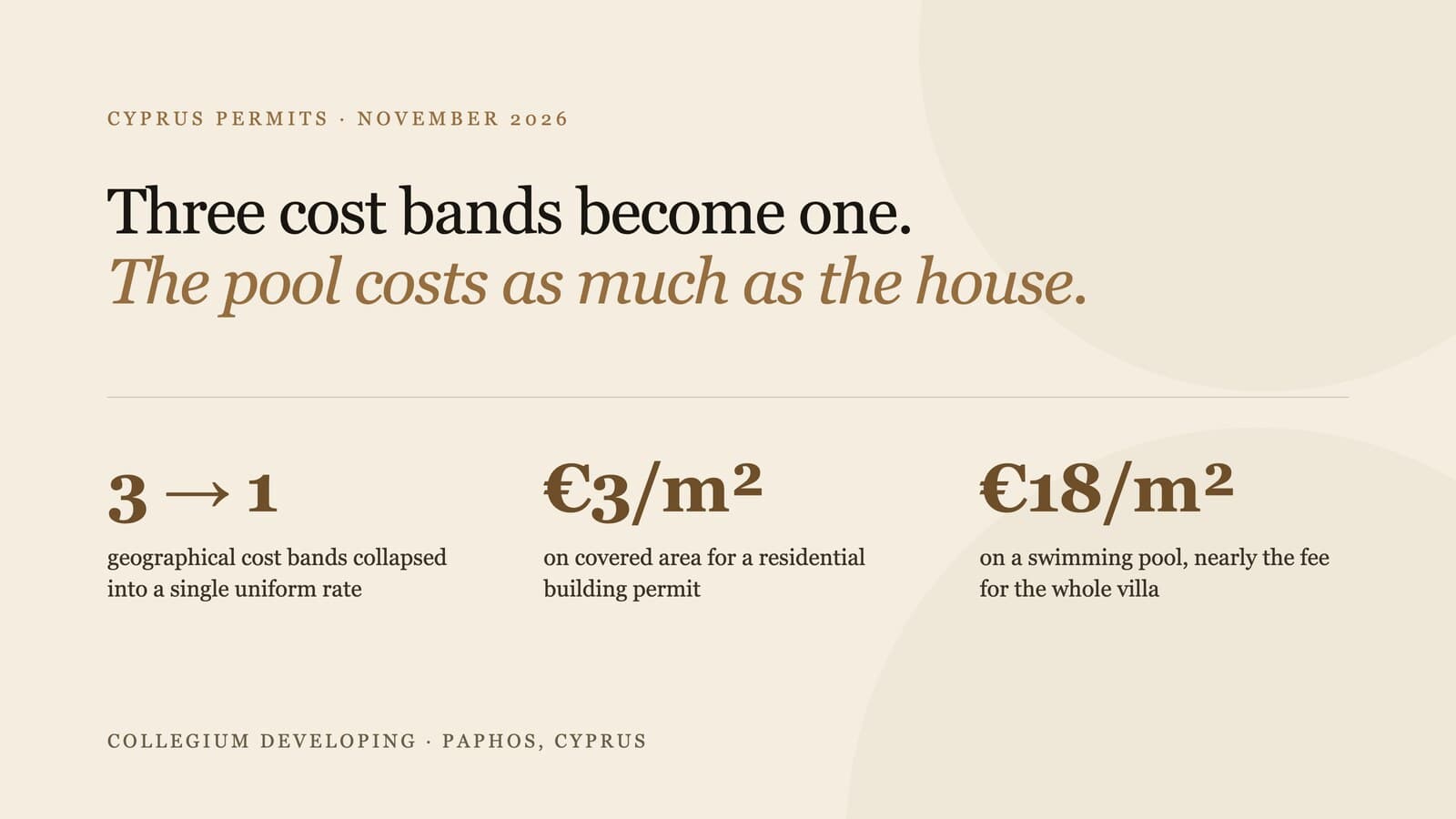
On 27 October 2026 the Cabinet approved a rewrite of those rules. The three bands are gone. The tiered area charge is gone. The extras on external works are gone when the external works form part of the main development. What is left is a flat table of rates per square metre, and for the first time in a long while a person with a tape measure and a calculator can work out their own number before they file. That is worth writing up properly, because as far as we can see nobody has published the new table in English yet.
One permit, two permits, and which one this touches
Before the numbers, a distinction that trips up almost every overseas buyer and quite a few local ones. Development in Cyprus normally needs two consents, not one. Planning permission comes first, under the Town and Country Planning Law, and it decides whether what you want to build is allowed on that plot at all: coverage, building coefficient, storeys, height, setbacks. We went through that machinery in detail in planning zones in Paphos. The building permit comes second, under the Streets and Buildings Regulation Law, and it deals with whether the thing is built properly: structure, fire, drainage, access, compliance with the building regulations.
The October reform amends the Streets and Buildings Regulations. It changes the fees for building permits and for land subdivision. It does not touch planning application fees, which sit on a separate schedule entirely. So if somebody tells you their permit costs have been simplified across the board, they have read half the story.
Both applications go through IPPODAMOS, the electronic platform that has been compulsory since 1 July 2024, and both are handled by the five District Local Government Organisations that took over from the old district administrations and municipalities. In Paphos that is the Paphos district organisation, and it is the body whose fee income this reform decides.
What the Cabinet actually approved
The amendments came to Cabinet on the proposal of the interior minister, Constantinos Ioannou, and they started life as a submission from ETEK, the scientific and technical chamber. They still need the approval of the House of Representatives before any of this is law, and that debate has not happened yet. Treat everything below as the shape of the thing rather than as the current charge until the House has voted.
Six changes matter. Fees become payable at the moment the application is submitted, which clarifies a process that previously left people guessing about timing. The division of Cyprus into three geographical categories with different cost coefficients is abolished, so the same development pays the same fee in Paphos as in Nicosia. The tiered charge based on floor area is abolished, for new buildings, for additions to existing buildings, for changes of use, for separation into independent units and for the subdivision of land into plots. The additional charges for external works that form part of the main development are abolished, which covers a wall or fence, uncovered verandas, parking spaces and the landscaping of a yard or garden.
Then there are two provisions that look like housekeeping and are not. If it turns out that more was collected than was due, the difference is refunded. If the applicant withdraws in writing within twenty days of submitting, twenty per cent of the fees is retained. And if a proposed development does not fit any of the defined categories, the fee is calculated by a method the interior minister sets, observing the principle that a charge of this kind should reflect the cost of providing the service. Hold on to that last phrase, because we come back to it at the end and it is the most interesting sentence in the whole instrument.
The new table, in full
Here is the schedule as approved. Residential development is charged at €3 per square metre of covered area. Commercial and office development is €5. Industry, light industry and warehousing, a category that also takes in petrol stations, mines and quarries, is €5 per square metre of covered area plus €1 per square metre of the uncovered areas of the development. Tourism is €6. Education is €5. Health, social care and welfare is €6. Sports facilities are €5 covered plus €1 uncovered. Recreation, entertainment and cultural uses are €5.
Places of worship and cemeteries are charged at €1 per square metre of the plot, or the part of the plot being developed, rather than on covered area. Agriculture, livestock and fish farming is €0.45 per square metre of covered area, with greenhouses and anti-hail installations at €0.10 and an agricultural store at €2 per square metre subject to a €100 minimum.
Infrastructure has its own lines. Electricity Authority substations, treatment plants, pumping stations and desalination works are €8 per square metre with a €100 minimum. A telephony mast is a flat €250. A photovoltaic park is €0.40 per square metre of the area of the installation, which is a number worth knowing given how much ground-mounted solar is being proposed on this island at the moment, and we wrote about where that market went in solar panels in Cyprus in 2026. A wind farm is charged at one per cent of the estimated value of the building works, the only line in the table that works off value rather than area.
External works, when they are not swallowed into a main development, keep their own rates. Parking areas and landscaping are €4 per square metre of the plot or the part of the plot being developed. A fence is a flat €140. A swimming pool is €18 per square metre of the surface of the pool, and that one is going to surprise people.
Conversions, additions and changes of use are calculated on the area of the conversion, addition or change of use, with a €100 minimum, as set out in an area schedule prepared by the designer. Mixed developments are the sum of the fees for each independent use under the categories above.
Subdivision, flats, and the small fees nobody quotes you
Land subdivision, meaning the vertical division of a parcel, is €0.20 per square metre of the area that comes out as a building plot or as open public space, with a €200 minimum. Amending that permit is €200. This is the line that matters if you are buying a field with a view to splitting it, and the wider process is the subject of buying land in Cyprus.
Dividing a building into units, whether vertically or horizontally, is €30 per unit, and amending that permit is €30 per unit amended. For a block of twenty flats that is €600, which is nothing against the cost of the block and is the fee that creates the separate titles your buyers will eventually register.
Opening or constructing a road is €0.50 per linear metre with a €50 minimum. A boundary adjustment is €120. A notification that a development is exempt from needing a building permit at all is €100. A copy of a permit is €25. Re-issuing a permit costs twenty-five per cent of the fees as they were originally calculated, with a €100 minimum, which is a quiet argument for not letting your permit lapse. And the certificate of approval, the document at the end that says the thing was built as permitted, costs five per cent of the permit fees with a €35 minimum.
A worked example: a villa above Paphos
Take a house we would actually build. One hundred and sixty square metres of internal space over two floors, thirty square metres of covered verandas because nobody in Cyprus wants a house without them, and a twenty square metre covered carport. That is two hundred and ten square metres of covered area, and at €3 the building permit fee is €630.
The boundary wall, the paved parking, the uncovered terrace off the kitchen and the garden landscaping all form part of the main development, so under the new rules they add nothing. Before the reform each of them would have attracted its own additional charge.
The pool is a different matter. An eight by four metre pool is thirty-two square metres of water, and at €18 per square metre that is €576. The pool costs nearly as much to permit as the entire house. We have read the schedule three times to be sure of that, and it does say what it appears to say. The certificate of approval at the end adds five per cent of the total, so about €60.
Call the whole permit file €1,270. Against a build cost that on current Paphos numbers lands somewhere between €350,000 and €450,000, which is the range we set out in building a house in Cyprus in 2026, the permit is about a third of one per cent. It is the cheapest meaningful line on the whole project. Remember that figure, because it is the hinge of the argument we make at the end.
Covered area is larger than the number in your head
One definition in the new schedule deserves a paragraph of its own, because people get it wrong and then feel misled. Covered area counts every space covered by a slab, on any floor of the building, whatever its use.
That means the covered veranda counts. The carport under a slab counts. The basement counts, and basements in Paphos are common because of how we build into slopes. The plant room counts. If you have been thinking of your house as a hundred and sixty square metre house, the permit sees two hundred and ten, and your fee is thirty per cent higher than the figure you had in mind. It is not a large sum either way. It is just better to know.
The same definition is why the abolition of the tiered area charge is more useful than it sounds. Under the old system a generous basement could push a project up a band and cost real money in permit fees. Now the rate is linear, so the hundred and eleventh square metre costs the same €3 as the first.
The external works change matters more than the money
Dropping the extra charges on walls, fences, uncovered verandas, parking and garden landscaping saves most householders a few hundred euro. That is not why we think it is the best part of the reform.
Every charge attached to an item on a drawing creates a small temptation to leave that item off the drawing. We have been shown permit sets in Paphos where the boundary wall is simply absent, where the terrace is drawn as a path, where the parking is a blank rectangle labelled nothing. The wall then gets built anyway, and what the owner has created, without knowing it, is unauthorised work. Unauthorised work is one of the standard reasons a title deed gets stuck, sometimes for years, and we went through exactly how that unfolds in title deeds in Paphos. Removing the charge removes the temptation. For a few hundred euro of lost fee income, the state buys itself more honest drawings, and a decade from now that is worth far more than the fee.
Which makes the pool line stranger. At €18 per square metre the pool is the single most expensive thing on a typical domestic permit, and it is precisely the item most often built later, quietly, by a man with a digger and no paperwork. If you were designing the schedule to discourage unauthorised swimming pools in Paphos you would not have written that number. Whoever is checking the drawings at the inspection stage, and we wrote about who that will be in Cyprus building inspections in 2026, is going to spend a good deal of time on pools that appeared after the certificate of approval.
What this does not fix
The ministry can point at real progress on speed. More than three thousand permits for detached and semi-detached houses have come out of the fast track for low and medium risk developments within forty working days, and more than fifteen hundred for apartment blocks of up to twenty flats within eighty working days. Those are the ministry’s own figures and we have no reason to doubt them.
Read them carefully though. Forty working days is eight calendar weeks. Eighty is about sixteen. Those are the good cases, the ones that qualified for the fast track because they are low or medium risk. A project that falls outside it waits longer, and nobody publishes how much longer. In October the valuers’ association used its annual meeting to call for faster and more predictable permits, crediting the ministry and the districts for progress while making it very clear that progress is not the same as arrival.
Predictability is the word that matters. A developer can plan around sixteen weeks. What a developer cannot plan around is not knowing whether it is sixteen weeks or thirty-four. The five per cent reduced VAT rate on a main residence, which we set out in VAT on Cyprus property in 2026, comes with deadlines attached, and permit delays have already forced the Tax Department to extend relief for applications caught by them. When a permit queue starts bending the tax code, the queue is the policy problem.
Our honest take, including the unpopular part
The uniform coefficient is correct and we would have done it years ago. An application in Paphos takes an officer the same number of hours as the same application in Nicosia. There was never a defence for charging differently by postcode, and the fact that almost nobody could tell you which band they were in tells you how much thought the bands were getting.
The flat table is correct too, and the gain is transparency rather than money. Any competent designer can now hand a client the permit fee on the day of the first meeting, to the euro. In a sector where people routinely sign contracts without knowing what the next invoice will say, that is a real improvement, and it came from ETEK rather than from the industry, which is worth noting.
Here is the part developers are not supposed to say out loud. The district organisations asked for the fees to go up. They argued that the current fees no longer reflect what it actually costs to examine an application, so the cost-reflective basis of the charge is not being met. ETEK agreed with them. The minister refused, with instructions that the fees be held as close as possible to today’s levels, and the districts are expected to raise it again when the regulations reach the House.
We think the districts are right and the minister is wrong, and we would pay more tomorrow. Go back to the villa above Paphos. The permit costs €1,270 on a build somewhere north of €350,000. Triple that fee and it is €3,800, still around one per cent of the project. Now price the alternative. Eight extra weeks of waiting on a build of that size, counting finance, the contractor’s programme, a rental the buyer is paying in the meantime and the general cost of having capital sitting in a field, costs a great deal more than €2,500. We would hand over the difference without hesitating if the permit came back on a date we could write into a contract.
Underfunding a review does not make it cheaper. It makes it slower, and a queue is just a price paid in time by people who cannot pass the cost on. The irony sits in the regulations themselves. The new provision for developments that fit no category says explicitly that the fee must observe the principle that a charge reflects the cost of the service. The instrument writes that principle into the one category almost nobody will ever use, while declining to apply it to the categories everybody uses every day.
Two smaller reservations. Twenty per cent retained on a written withdrawal within twenty days is defensible in principle, since the district has done work by then, but twenty days is short and in practice the people who withdraw are usually correcting a design team’s mistake rather than changing their mind. And payment at submission is a change self-builders should budget for. You now pay before you know whether you are getting the permit, and if you pull out you get back eighty per cent at best.
None of which should put anybody off. The permit fee is the cheapest part of building in Cyprus and it has just become the easiest part to calculate. If you want a developer who can tell you what your file will cost before you commission a single drawing, that is a reasonable test to set, and we set out a few more of them in choosing a property developer in Paphos.
The regulations described here were approved by the Cabinet on 27 October 2026 and require the approval of the House of Representatives before they take effect. The figures come from public reporting available at the start of November 2026 and may change in the parliamentary debate, not least because the district organisations intend to press for increases there. This is not legal, tax or planning advice. Confirm the current fees with the Paphos District Local Government Organisation or through IPPODAMOS before you rely on them, and have your application prepared by a licensed architect or civil engineer.
Want your permit file costed properly?
Send us the plot and a rough idea of the house and we will tell you what the permit will cost, what the pool adds, and roughly how long the district is taking on files like yours right now. No obligation and no sales pitch.