Who Actually Checks Your New Home? Cyprus in 2026
The question buyers almost never ask
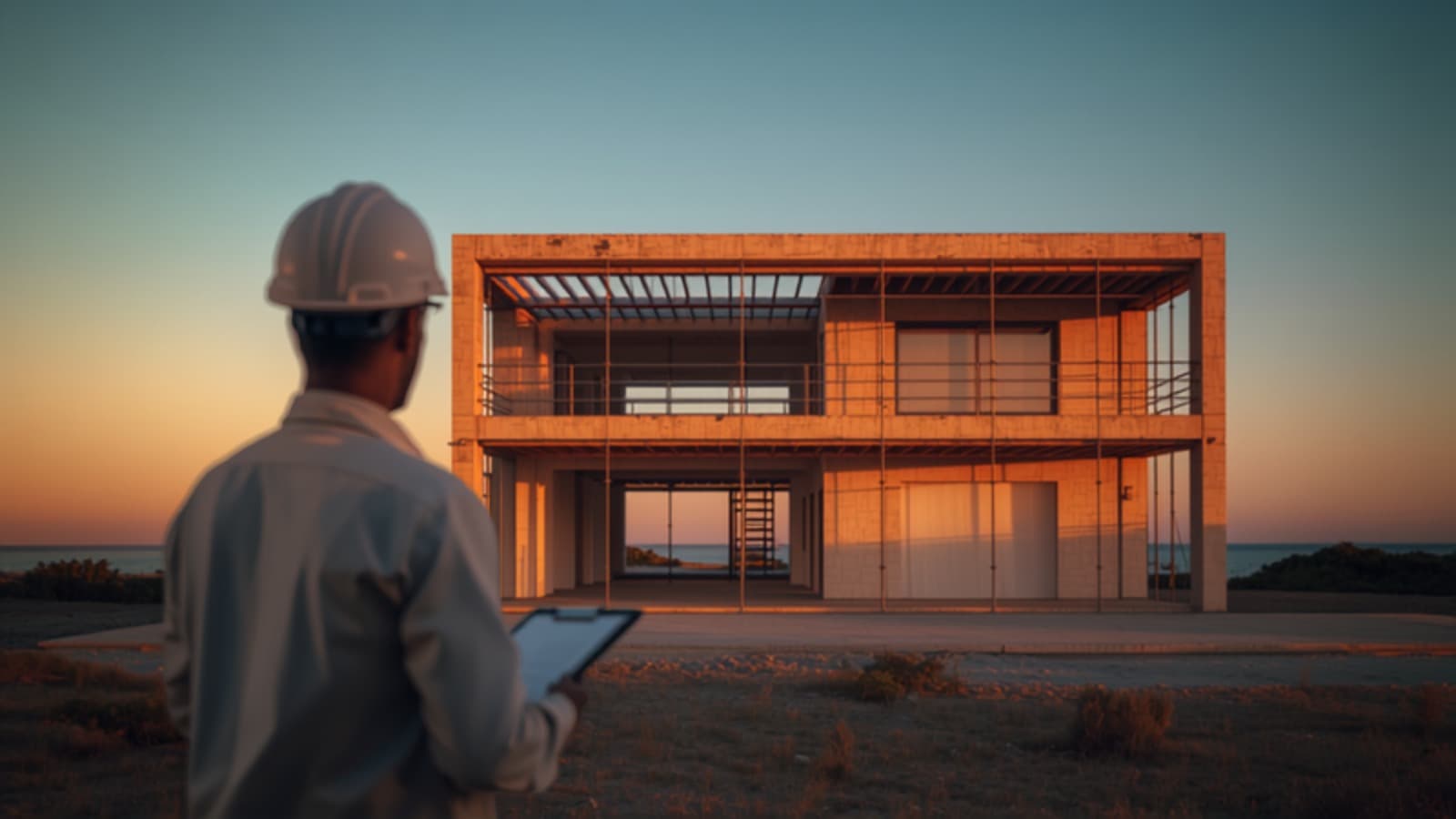
People viewing an unfinished home ask us about the kitchen brand, the tile format, the depth of the pool and whether the third bedroom will really take a double bed. In fifteen years we can count on one hand the number who have asked the question that actually decides whether the house is any good, which is this. Between the permit being stamped and the keys being handed over, who comes to site and checks that the building matches the drawings?
The honest answer in Cyprus today is: not many people, and mostly people the developer is paying. That is the thing two separate pieces of proposed legislation are trying to change this year, and between them they would be the biggest shift in construction oversight here in decades. One would put independent inspectors on site during the build. The other would make property development a licensed profession for the first time. Neither is law yet. Both are worth understanding before you sign anything.
How it works right now
A development in Cyprus needs a planning permit and then a building permit, both filed through the government’s IPPODAMOS portal. Those approvals are real and the technical review behind them is genuine. What is thin is what happens afterwards. The district authority that issued the permit is supposed to inspect, but it is issuing thousands of permits a year with a headcount that has not grown to match, so in practice site inspection is light and often reactive. The people on site every week are the architect and engineer appointed by whoever is building, and the certificate of final approval largely rests on their word.
That system works fine when the developer is competent and honest. It has no answer at all when the developer is neither, which is why the gap between the approved drawings and the finished building has been a running theme in Cypriot property complaints for thirty years. Extra floor area that was never permitted. Balconies that grew. Waterproofing details quietly value engineered out of existence. Most of it never surfaces until the building tries to get its separate title, or until something fails.
The independent inspector bill
In June the Ministry of the Interior put a draft amendment to the Roads and Buildings Law out for public consultation, opening on 7 June and closing on 7 July 2026. The idea is straightforward. A new category of independent Building Inspector would carry out on-site inspections on behalf of the competent authority, at set stages of construction, and confirm that what is going up matches what was approved.
The eligibility bar as drafted is high, which we think is deliberate. An inspector would need to have been a member of ETEK, the Cyprus Scientific and Technical Chamber, for at least ten years, with at least ten years of professional experience in design, site supervision or licensing, a valid practising licence and professional indemnity insurance. ETEK would hold the central electronic register. Conflict of interest rules would stop an inspector from signing off a project they have any direct or indirect connection to, which is the whole point and also the part that will be hardest to police on an island this size.
Inspections would land at the moments that matter rather than at random: foundations complete, structural frame complete, and practical completion. The fees discussed in the draft are modest, in the region of a couple of hundred euros per visit on a house under 250 square metres and several hundred to around a thousand per stage on larger commercial work. Inspectors who are negligent or who file false reports would face fines, suspension, or removal from the register altogether.
Our view, as the people who will pay for it
We are in favour, and we want to be clear that this is not a costless position for us. Every inspection is a fee we pay, a date we have to hit and a person with the authority to tell us to open something back up. We still think it is one of the better ideas to come out of the Ministry in years, for a simple commercial reason. Right now a buyer standing in front of two half-built houses has almost no way to tell the careful developer from the cheap one, because both sites look like scaffolding and rebar. When you cannot demonstrate quality, quality stops being worth paying for, and the whole market drifts towards the lowest cost that will pass. An independent signature at the frame stage is how you break that.
Two honest reservations. The first is capacity. There is a finite number of engineers and architects in Cyprus with ten years of ETEK membership and the right experience, they are already busy, and a good number of them are conflicted out because they work for or with the firms building the projects. If the register turns out to hold a few dozen genuinely independent names covering the whole island, the inspection either becomes a bottleneck or becomes a formality. Neither helps.
The second is that the fee levels only work if the inspection is real. Two hundred euros buys a proper hour on a villa site. It does not buy a proper afternoon on a fifty-unit block, and if the pricing pushes inspectors towards fast drive-by visits, the industry will have bought itself a certificate rather than a check. We would rather pay more and get someone who actually climbs the scaffold.
The second reform: licensing developers
Here is the fact that surprises almost every foreign buyer we meet. There is currently no law in Cyprus that says who may act as a property developer. Contractors are regulated and have their own register. Estate agents are regulated. Developers, the people who buy the land, design the scheme, take your deposit and hold your money for two years while they build, are not. Anyone can register a company on a Monday and be selling off-plan apartments by Friday.
The Cyprus Property Developers Association, whose members account for a large majority of the organised market, has put a draft law to the Ministry of the Interior to create the profession of land development professional, with a register and entry criteria covering competence, experience and conduct. It is being worked through by a joint working group of ministry officials, the Lands and Surveys Department, Town Planning and the association, and it has the Interior Minister’s support in principle. It applies to developers rather than to building contractors, who already sit under separate legislation. As of this August it is still a draft rather than a law, and Cypriot bills change shape on the way through the House.
We support it, including the parts that would make our own life more bureaucratic. A trade association proposing to restrict entry to its own trade always deserves a sceptical read, and you should apply that scepticism here too. But the current position is genuinely indefensible. The one relationship in the whole transaction where a buyer is most exposed, handing over staged payments for something that does not exist yet, is the one with no professional qualification behind it at all. Until that changes, the checks in our guide to choosing a property developer in Paphos are doing work that a register ought to be doing for you.
Permits got faster. That is exactly why this matters
The backdrop to both bills is that the government has spent two years speeding up licensing, and it has worked. Speaking to the developers’ association in Limassol in late June, Interior Minister Constantinos Ioannou said the reform had licensed roughly 3,000 homes within 40 working days and around 1,000 apartment buildings within 80 working days, and called it one of the most important interventions of recent years. Anyone who filed a permit here in 2019 will tell you those numbers would have sounded like fiction.
We benefit from that directly and we are not going to pretend otherwise. But faster approval and unchanged verification is a combination that only points one way. If the state is going to process permits at speed, it needs a way of confirming that the buildings actually match them, and it cannot do that with the same stretched district inspection teams. The two reforms are really one policy. Approve quickly, then check properly.
What none of it fixes: the buildings already standing
This is the part that gets lost. Every reform on the table applies to new construction. The failures Cyprus has actually seen recently have been in older buildings. A collapse in Limassol in April killed two people and injured four. In June, balconies on the third and fourth floors of a seven-storey block in the Kapsalos area of Limassol gave way onto a parked car, in a building the district governor said had not been classified as dangerous although the municipality had already written to it about damage to external walls and balconies needing maintenance.
ETEK has been asking for years for a mandatory periodic inspection regime for existing buildings, the equivalent of an MOT, and its secretary general repeated the call after the June incident, pointing at an ageing stock much of which went up before modern building regulations existed. We think that is the more urgent of the two problems and it keeps losing to the newer, easier one. Nobody wants to be the minister who tells thousands of apartment owners they now owe money for structural surveys and repairs to a block whose management committee has not met since 2011.
The practical consequence for a buyer is simple. If you are looking at a resale apartment in a block built in the seventies or eighties, none of this year’s legislation is protecting you. Pay for your own structural survey, look hard at the balconies and the exposed concrete for rust staining and spalling, ask to see the management committee’s accounts and minutes, and ask what has been spent on the building in the last decade. If the answer is nothing, that is not a saving. That is a bill that has not arrived yet.
The Land Registry changes running alongside
While this is going on, the Department of Lands and Surveys has its own modernisation planned for 2026, and two parts of it touch ordinary buyers. Transfer fees are set to be calculated on the price declared in the sale contract rather than on a separate government valuation, with valuations reserved for exchanges and for cases where a price looks artificially low. And the department is working through roughly 150 forms, most of them still paper, to get a meaningful share of applications filed electronically with published guidance.
There is also a new framework for auctioning undivided shares in co-owned property, with a central auction venue and private valuers involved, aimed at unlocking something in the order of 866 properties currently frozen by co-ownership disputes. If you have ever been offered a cheap share in a family plot, that is the machinery you were about to walk into. Transfer fees, VAT and the rest of the closing arithmetic are set out in our breakdown of the true cost of buying property in Cyprus, and the separate title question sits in our guide to Cyprus title deeds.
What to ask your developer before the law arrives
None of these bills will help you if you are buying this autumn, so use them as a specification instead. Ask to see the planning permit and the building permit, not a summary of them, and check that the drawings attached match the unit you are being sold. Ask who the supervising architect and civil engineer are, whether they are independent of the developer or in-house, and how often they attend. Ask for the structural design and the waterproofing detail in writing.
Then ask for the thing the bill would give you anyway: write stage inspections into your contract. Nominate your own engineer, at your own cost, with a right of access at foundations, at frame completion and before final payment. It costs a fraction of a per cent of the purchase price. A developer who refuses that has told you something important, and a developer who agrees without flinching has told you something too. We put ours in writing because we would rather be checked than trusted, and because the inspection almost always ends with a coffee rather than a disagreement.
If you are buying before completion, the payment structure matters as much as the building. Stage payments tied to verified construction milestones rather than to dates in a calendar are the single best protection a buyer has, and we go through how that should be drafted in our guide to buying off-plan property in Paphos. If you are building on your own land instead, the same inspection logic applies from the first pour, and the ground rules are in buying land in Cyprus, and the permit route, the fast-track deadlines and the 2026 cost of getting a house out of the ground are in our guide to building a house in Cyprus in 2026.
Where we think this lands
Our guess, and it is a guess, is that the inspector regime arrives in some form within the next couple of years, softened at the edges, with a longer transition than the draft implies and a narrower definition of which projects are caught. The developer register will take longer because professional registers always do, and it will end up grandfathering in most of the people already trading. Neither will be the clean break the press releases promise. Both will still leave the industry better than they found it.
What will not change is the underlying arithmetic that makes this necessary. Construction costs in Cyprus hit record levels last year and remain under pressure, borrowing is expensive, and margins on mid-market housing are tight. When those three things happen at once, the temptation to save money where nobody is looking gets stronger, and the places nobody looks are always structural, always hidden and always the expensive ones to fix later. That is the case for inspection in a sentence, and it is why we are relaxed about being on the receiving end of it. The wider market picture behind those pressures is in our Paphos property market outlook for 2026, and the specification side of building properly, where most of the long-term running cost is decided, is in our piece on energy-efficient new homes in Cyprus.
One last thought
Regulation usually arrives in this industry after something goes wrong, and it is written by people trying to make sure the last failure does not repeat. That is a poor way to run a construction sector but it is the way most countries have ended up with decent building control, and Cyprus is simply doing it later than northern Europe did. The developers complaining loudest about the cost of an inspector are, in our experience, rarely the ones you would want building your house.
Come and inspect us.
Bring your own engineer to one of our sites, at any stage, and look at the frame before it disappears behind plaster. We will show you the permits, the structural drawings and the details that never make it into a brochure. Ask us anything, including the awkward questions.