Net Metering Is Gone Solar Panels in Cyprus in 2026
The roof that stopped paying
A client of ours in Chlorakas rang us in March. She has a five-kilowatt array that we put on her roof in 2022, and for three winters it had done exactly what she was told it would do. It banked credit in the mild months, she spent that credit running the air conditioning in August, and her electricity bill for the year came to almost nothing. Then the February bill arrived and the credit balance she had built up was gone. Not spent. Zeroed. There was no note on the bill and no letter before it.
She was not singled out. Thousands of households across Cyprus opened the same bill and found the same thing, and it landed in the middle of a much larger change that most people buying a home here still have not been told about. Net metering, the arrangement that made a rooftop array in Cyprus close to a licence to print money, closed to new applicants on 31 December 2025. What replaced it on 1 January is a different proposition with different arithmetic, and it rewards a different kind of installation.
We build houses in Paphos, so this is not an abstract policy question for us. Every villa we hand over has an array on the roof and a buyer who wants to know what it will save them. The honest answer in 2026 is a good deal more complicated than it was in 2023, and anybody who gives you a simple one is either behind the news or selling you panels.
What actually changed on 1 January
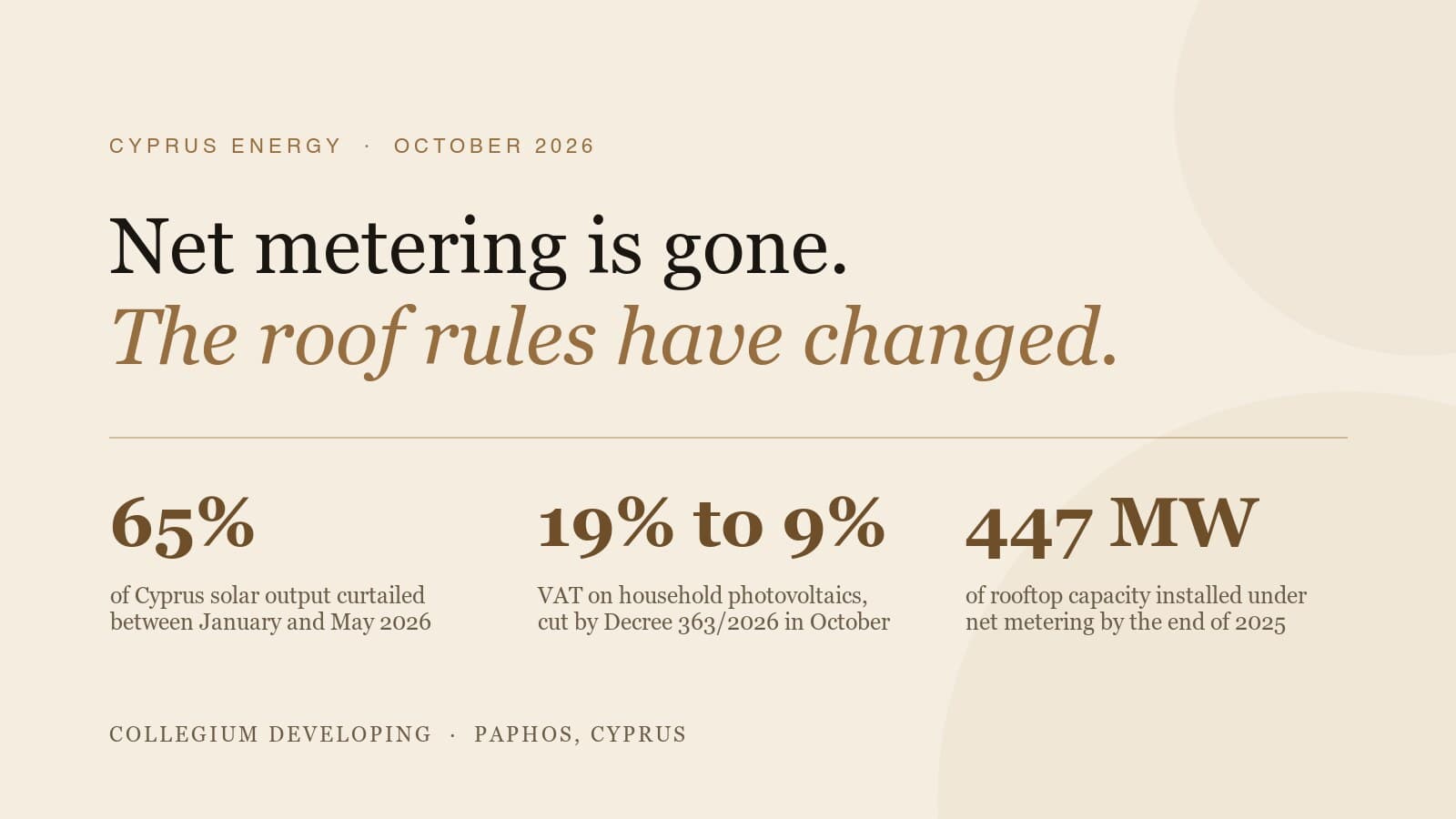
Under net metering, the meter ran backwards. You exported a unit at midday, you imported a unit at nine in the evening, and the two cancelled out at the retail price. The electricity you sent to the grid was worth exactly what the electricity you took back out of it cost. That is an extraordinarily generous settlement and it is why Cyprus ended 2025 with 93,490 net-metering systems on its roofs, adding up to roughly 447 megawatts, according to the Electricity Authority of Cyprus. Nearly 20,000 of those went up in 2025 alone.
Net metering for households and net billing for commercial systems both closed at the end of 2025. From 1 January 2026 new installations fall under a market-based self-consumption framework designed by the Cyprus Energy Regulatory Authority, which followed the full opening of the electricity market on 1 October 2025. The practical effect is that the unit you export is no longer worth the unit you import. It is worth something closer to the wholesale price at the moment you exported it, and the moment you export it is the moment the wholesale price in Cyprus is at its lowest.
You now have three routes for surplus generation. You can sign a bilateral contract with an electricity supplier on whatever terms the two of you agree. You can join an aggregator that bundles your output with other people’s and sells it into the market. Or you can decline to export at all and simply use what you generate. Existing net-metering contracts stay in force, which matters a great deal if you are buying a resale property with an array already on it, and we come back to that below.
The February bills, and the 36-month rule
The credit reset is a separate story that got tangled up with the regime change, and it is worth understanding because it tells you something about how much of this was communicated.
The Electricity Authority points to an amendment to the energy ministry’s scheme approved by cabinet in March 2023. Under it, standard household systems carry a 36-month limit, and on the last bill of those 36 months any accumulated surplus is zeroed. The Authority applied one common clearing date to every system, so the February and March 2026 billing periods cleared the lot. Customers reading their own contracts, which say surpluses roll forward with no year-end settlement, were understandably furious. A number of them argue the 36 months should run from each system’s own installation date, which would leave newer arrays untouched for years yet.
We have no view on who wins that argument, and it may well end up being settled somewhere other than a call centre. What we would point out is that a policy decision taken in March 2023 reached most of the people it affected as an unexplained number on a bill almost three years later. One Paphos resident quoted in the press in March had lost 7,000 credits after four grid disconnections in five days. That is not a communications failure at the margin. It is the kind of thing that makes people distrust the next scheme, and there is a next scheme.
Sixty-five per cent, thrown away
Here is the number that explains everything else in this article. Between January and May 2026 Cyprus curtailed roughly 162 gigawatt-hours of renewable generation, which is more than 65 per cent of what the island’s solar could have produced in that period. Curtailment means the grid operator tells the plant to stop, so the sunshine falls on the panels and nothing comes out of them.
That figure has moved fast. Curtailment ran at about 12 per cent in 2022 and 47 per cent in 2025. Small rooftop and residential systems were barely touched at first and then were not. The curtailed volume from small-scale PV was 1,565 megawatt-hours in 2024, 30,180 megawatt-hours in 2025, and 46,687 megawatt-hours in the first five months of 2026 alone. If the pattern holds, Cyprus will close 2026 having thrown away more than 60 per cent of its solar output, which would be a record for any European grid.
The reasons are structural rather than mysterious. Cyprus is an electrical island with no interconnector, so surplus power has nowhere to go. Conventional generating units have to keep running to hold the system stable, and they occupy capacity that solar could otherwise fill. At the middle of the day the day-ahead price falls to zero or near it, while the evening peak, when everybody comes home and turns things on, is served by thermal plant costing somewhere in the region of 180 to 250 euros per megawatt-hour. The island generates far too much electricity at noon and not nearly enough at eight.
The fix is storage, and it is coming late. Contracts for about 120 megawatts of centralised batteries, costing around 50 million euros and managed by the transmission operator, were signed in June 2026. Delivery is expected in January 2027 and operation by the summer of 2027, with sites at substations including one here in Paphos. A further 36 private battery applications totalling roughly 925 megawatts are in the queue. All of that will help. None of it helps the array going on a roof this winter.
The VAT cut, and what it is actually worth
On 16 October 2026 the Council of Ministers approved Decree 363/2026, which cuts VAT on the purchase and installation of household photovoltaic systems from 19 per cent to 9 per cent. It takes effect on publication of the decree in the Official Gazette. This is ten days old as we write, and most of the quotes circulating in Paphos this month were priced before it.
Run the arithmetic on a real system. A five-kilowatt array on an average family house in Cyprus comes in at somewhere between 6,500 and 9,000 euros installed. Take 7,500 euros as a fair middle. At 19 per cent VAT the tax inside that price is about 1,197 euros. At 9 per cent it is about 619 euros. The saving is roughly 580 euros, or a little under 8 per cent off the total. On an eight-kilowatt array for a larger villa with an EV charger, where the installed price runs 10,000 to 14,000 euros, you are looking at somewhere between 800 and 1,100 euros.
It is a real cut and we welcome it. It is also not the thing that decides whether a system is a good investment, and we would rather buyers understood that than treated it as a reason to rush. Note too that it is a separate measure from the reduced 5 per cent VAT on a primary residence, which has its own rules, its own square-metre caps and its own transitional deadlines. We set those out in our guide to VAT on Cyprus property in 2026. If the array is specified and priced inside the build contract for a new home, which is how we do it, the VAT treatment follows the contract rather than the decree, so ask the question rather than assume the answer.
The grant scheme that will not help you
There is a 20 million euro residential energy upgrade scheme open right now. Applications for Save and Upgrade Homes opened at nine in the morning on 20 October 2026 and run until the end of 30 December 2026, or until the budget is exhausted, on a first-come basis. Grants reach 32,000 euros per home, with higher rates for vulnerable households, mountain communities and state refugee settlements. Photovoltaics up to 10 kilowatts and battery storage up to 4 kilowatt-hours are both eligible, which is exactly the combination the new regime calls for.
Read the eligibility rule before you get excited. The property must have been first connected to the electricity network before 1 January 2008, or have had a planning or building permit application submitted before 21 December 2007. You also need an energy performance certificate issued no earlier than 15 May 2026 before you apply.
So if you own a 1990s house in Mesogi with single glazing and a 1980s boiler, this scheme is aimed squarely at you and you should be on the portal today. If you are buying a new villa from us, or any home built in the last eighteen years, you are not eligible and no amount of paperwork will make you so. That is defensible as policy, because the worst-performing housing stock is where public money does most good. It is also worth saying plainly, because we have already had two buyers this month ask whether we could get them into it.
The other thing the scheme reveals is a timing problem. Solar applications slowed noticeably through 2026 while households waited for a subsidy that paired panels with batteries. Of the roughly 1,835 standalone self-consumption applications filed between January and late August, only 137 included storage. People worked out that panels without a battery no longer pay the way they used to, and then sat on their hands waiting for help with the battery. Nine months of installation activity went quiet while the island was curtailing two thirds of its solar.
How we size and wire a system now
The design brief has genuinely changed, and this is the part we would want a buyer to understand because it is where the money actually is.
Size to the daytime load, not the roof
Under net metering the right answer was to fill the roof, because every exported unit came back at full value. Under self-consumption the right answer is to cover what the house actually uses while the sun is up, plus a margin, and then stop. A 12-kilowatt array on a house that draws two kilowatts during the day is not twice as good as a six-kilowatt array. It is the same house with more panels exporting more electricity at a price near zero, and on bad days exporting nothing at all because the grid has told it to stop.
Point some of it west
Due south maximises total annual yield, which was the right target when every unit was worth the same. It also concentrates your generation into the hours when the grid least wants it. Splitting an array so that part of it faces west shifts output into the late afternoon and early evening, closer to when a Paphos household is cooking, cooling and charging. Total yield falls slightly. The value of the yield rises.
Pre-wire for a battery even if you do not fit one
Batteries add 4,000 to 8,000 euros to an installation, and plenty of buyers will not want that on day one. Leaving space in the plant room, running the right cable, sizing the consumer unit and specifying a hybrid inverter rather than a string inverter costs very little at build stage and saves a meaningful retrofit bill later. We now do this as standard on the villas we build in Paphos, and we would ask any developer you are talking to whether they do the same.
Give the surplus somewhere useful to go
A hot water cylinder with an immersion diverter is the cheapest battery in the house. So is a pool pump on a midday timer, an EV charger set to draw only from surplus, and a heat pump running the cylinder up at two in the afternoon rather than at six in the morning. None of this is exotic and all of it turns electricity you would have exported for nothing into hot water or a charged car. This is also where the controls side earns its keep, which we go into in our piece on smart home systems in Cyprus villas.
Get the fabric right first
An array is not a substitute for insulation, shading and decent glazing. A house that needs four kilowatts of cooling at three in the afternoon will always be worse than one that needs two, whatever is on the roof, and the EU building rules now pushing Cyprus towards zero-emission new homes are aimed at the fabric first. We covered where those rules are going in energy-efficient new homes in Cyprus, and the Energy Performance of Buildings Bill implementing the latest directive was tabled in parliament on 17 September 2026 and is not yet law.
What a system is worth on a new Paphos home
Take a three-bedroom villa, occupied year round by a couple who are at home a good part of the day. Electricity in Cyprus costs roughly 29 cents a kilowatt-hour all in, once network charges, levies and VAT are on the bill, against an Electricity Authority energy component of around 10.3 cents. That gap is why self-consumption works and export does not: every unit you avoid buying saves you the whole 29 cents, while every unit you export earns you a fraction of the wholesale price.
A five-kilowatt array in Paphos will generate something in the order of 8,000 kilowatt-hours a year. Without a battery and without any load shifting, a typical household self-consumes perhaps 30 to 40 per cent of that, so call it 2,800 kilowatt-hours avoided, worth about 810 euros. Add a sensible battery, a diverter on the cylinder and a pool pump that runs at noon, and self-consumption of 60 to 70 per cent is realistic, which is more like 4,800 kilowatt-hours and 1,390 euros. The exported remainder contributes something, but we would not build a case on it, and on a curtailed afternoon it contributes nothing.
Against an installed cost of about 7,500 euros after the VAT cut, the no-battery version pays back in roughly nine years on self-consumption alone. The version with a 5,000 euro battery costs 12,500 and returns about 1,390 a year, so nearer nine years again, with the difference that it also carries the house through an evening peak and an outage. Those are duller numbers than the three to five year paybacks you will see quoted on installer websites, and the reason is simple: most of those figures were calculated when exports were worth retail. Treat any payback claim that does not state its self-consumption assumption as marketing.
Two things improve that picture materially. Rising electricity prices, which we would bet on rather than against, and the Great Sea Interconnector, if it ever arrives, which would give surplus Cypriot solar somewhere to go. We write about where household running costs sit now in our guide to the cost of living in Cyprus, and electricity is the line that has moved most.
If you are buying a resale with panels already on it
This is the part almost nobody checks, and it can be worth thousands.
Existing net-metering contracts remain in force. A house that was connected under net metering carries an arrangement that no new installation can get, and that arrangement is a genuine asset. So ask for the contract rather than taking the seller’s word for it. Ask which scheme the system sits under, when the contract was signed and when it expires, because a contract expiring after 1 January 2026 moves the system onto the new framework. Ask whether the contract transfers to you on sale and what the supplier requires to effect it. Ask what the 36-month clearing date is for that specific meter, since that question is still live.
Then ask the dull technical questions. How old are the panels and the inverter, because an inverter is a ten to fifteen year item and replacing one is not trivial. Is there an export limiter and how is it set. Was the installation registered and inspected properly. Is there a warranty and does it survive the sale. We go through this kind of thing in our guide to building inspections in Cyprus, and a surveyor who will not climb onto the roof is not finishing the job.
If you are buying to let, the arithmetic flips again. A holiday let in Paphos has almost all of its load in the evening and overnight, in July and August, with nobody in the house at midday. An array without storage on a rental property is close to a donation to the grid. With storage, it covers a good part of the evening air conditioning that drives your bills. We look at the wider numbers on letting in renting out property in Paphos in 2026.
Our honest take
The policy here was sequenced backwards and we do not think that is a controversial thing to say. Cyprus spent four years paying householders retail rates to put panels on roofs, built 447 megawatts of rooftop capacity on that promise, and only contracted its first 120 megawatts of grid batteries in June 2026, with operation expected in the summer of 2027. The storage arrives roughly two years after the grid started refusing the power. In the meantime the island will throw away something like two thirds of a year’s solar generation, and the households who were encouraged to invest are the ones being disconnected on sunny afternoons. If you are going to subsidise generation on an isolated grid, you build the sink first. That is not hindsight, it is the order of operations.
On the VAT cut, we are glad of it and we think 9 per cent is the right number, but cutting the tax on panels in the same year the grid starts curtailing household systems is an odd combination of signals. The cut makes a marginal system slightly less marginal. It does nothing about the fact that the binding constraint is now storage, and the measure that would have moved the market fastest was a straightforward grant on home batteries, available to every house rather than only to those connected before 2008. Nine months of installations stalled while people waited for exactly that, and the scheme that eventually opened on 20 October excludes every home built this century.
Where does that leave a buyer. We would still put solar on a new house in Paphos, without hesitation, and we do. We would size it to the daytime load rather than the roof area, split the orientation to push output into the late afternoon, specify a hybrid inverter and leave the battery as a decision the owner can make in year two, and we would spend money on insulation and shading before spending it on the eleventh panel. We would not promise anyone a four-year payback, and we would be wary of anybody who does.
The broader point is the one we keep coming back to in these pieces. The things that determine what a Cyprus home costs to run are changing faster than the sales literature, whether that is electricity, the water situation on the island, or the build standards themselves, which we set out in building a house in Cyprus in 2026. A developer who can tell you what the self-consumption framework did to your roof in January is probably also keeping up with the rest of it, and one who cannot is worth a second look. We wrote about how to run that check in choosing a property developer in Paphos.
This article describes energy rules, tax measures and a grant scheme that are moving quickly, and it is not legal, tax or engineering advice. The figures quoted come from public reporting and operator data available in October 2026 and will change. Confirm the current position with the Cyprus Energy Regulatory Authority, the Electricity Authority of Cyprus, the Tax Department and the Ministry of Energy, Commerce and Industry, and have any installation designed by a licensed electrical engineer before you commit to it.
Want the array sized properly?
Tell us how you will live in the house and we will tell you what size array makes sense, what a battery would add and what it should cost. We will also tell you when the answer is fewer panels. No obligation and no sales pitch.