The Rain Came Back. Our Water Spec Did Not Change. Cyprus in 2026
Five months that told two completely different stories
In January the news out of Cyprus was as bad as it has ever been on water. Dams were down to roughly 13 per cent of capacity, inflows were the lowest since records began in 1901, households were asked to cut consumption by a tenth and farmers were told to expect 30 per cent less irrigation water than the year before. Kouris, the biggest reservoir on the island, was at about 12 per cent. Every buyer we spoke to that month asked us some version of the same question, usually apologetically, which was whether the island was running out of water.
Then March delivered 35.4 million cubic metres of inflow, the most in forty years. April came in at 23.6 million, the second best April on record, with rainfall at 175 per cent of normal. May produced the strongest inflow for that month since the department started keeping detailed records in 1987. By the middle of August the dams were holding 113 million cubic metres, just under 39 per cent of capacity, and nobody was asking us about water any more.
We think that swing, and the speed with which everyone forgot the first half of it, is the most instructive thing that has happened in Cypriot property this year. It is also why our specification did not move an inch when the rain arrived.
Where Paphos water actually comes from
Most people buying here assume there is a single national water system and that it either works or it does not. The reality is more local than that, and if you are buying in Paphos it is worth knowing which pieces of it you are relying on.
The district has two significant reservoirs. Asprokremmos, above Kouklia, is the big one, and in mid-August it was holding around 52 million cubic metres at 39 per cent full. Evretou, in the Polis direction, was at 43.5 per cent with about 24 million cubic metres. Those numbers are healthier than the island average and a great deal healthier than they were in February, which is the good news. The less comfortable news is that both are surface reservoirs whose level is decided entirely by what falls on the south-western side of Troodos in a given winter, and the last decade has made clear that is not something you can plan a twenty-year mortgage around.
The second source is desalination, which now supplies roughly 70 per cent of the island's drinking water. Paphos has had a rougher ride with it than most. The permanent plant at Kouklia, which used to produce 15,000 cubic metres of drinking water a day, went out of service, and the stopgap installed on the same site handles 1,350 cubic metres a day, which is under a tenth of what was lost. A larger mobile unit at Kissonerga has been due to come online around September. The government put 196 million euros into water measures for 2026, 140 million of it simply buying desalinated water, and plans a dozen desalination units running by the height of summer.
Put plainly: the coastal towns did not run out of water this year, and they are not likely to next year either, because desalination is now doing the heavy lifting for exactly the areas where most foreign buyers live. What has changed is the cost structure sitting behind the tap, and cost structures have a way of reaching the household bill eventually.
Why we did not relax anything when the dams filled
We have been building in Paphos long enough to have watched this cycle run three or four times. A dry couple of years, a genuine scare, a wet spring, and then a collective decision to treat the wet spring as the end of the story. The specification decisions taken during the scare quietly get value engineered out again, and the next drought finds the housing stock exactly as unprepared as the last one did.
Our position, which we will happily defend to anyone who thinks it is overcautious, is that a house being built in 2026 will still be standing in 2076, and that the water assumptions built into it need to survive more than one wet winter. Rain is weather. The structure underneath it is climate, an ageing distribution network that loses something in the order of 40 per cent of what goes into it, a population that keeps growing, and an economy where tourism and agriculture both want the same litre. None of those four things improved between January and August. Only the rainfall did.
There is a commercial argument for it too, and we would rather be honest about that than pretend we are only being virtuous. A house that handles a dry year without drama is worth more than one that does not, and the difference shows up at resale in a market where buyers get steadily more sophisticated about running costs. The same logic runs through everything we have written about energy-efficient new homes in Cyprus. The cheap decision at build stage is almost always the expensive one over thirty years of ownership.
What a water-sensible Cypriot house actually has
None of this is exotic. Most of it is ordinary Cypriot building practice done properly rather than done to the minimum, and the total cost on a villa is a fraction of what people spend on a kitchen upgrade.
Storage that means something
Almost every house in Cyprus has a roof tank. What varies wildly is how much it holds and whether anyone thought about it. The default on a lot of developments is a tank sized to cover a short interruption in supply, which is fine for a burst main on a Tuesday and useless if the district is on rota. We size for several days of normal household use rather than several hours, and we would rather put the volume in a properly supported, insulated, opaque tank than in a cheap translucent one that grows algae every August. If you are looking at a house that is already built, ask for the tank capacity in litres. If nobody on the sales side knows the number, that tells you how much thought went into it.
Pipework for greywater, even if the system comes later
Cyprus is actively encouraging greywater reuse, sending shower and basin water to garden irrigation and toilet flushing rather than to the sewer, and there is public support available for households that install it. The systems are not expensive. What is expensive is retrofitting the second drainage run into a finished house, because that means chasing walls and lifting floors.
So we separate the greywater drainage at first fix as a matter of course, whether or not the buyer wants the treatment unit on day one. It adds very little to a build that is already open. It means the decision stays available for the next forty years instead of being closed off the day the screed goes down. We think this will be mandatory in new build within the decade, and we would rather be early than have to explain to a buyer in 2032 why their house cannot take a system their neighbour just fitted.
A garden that does not need a hosepipe
This is where most water in a Cypriot villa actually goes, and it is the part buyers most often get talked into by a landscaper who is paid to plant, not to run the place. A lawn in Paphos is a standing order. Carob, olive, oleander, lavender, rosemary, bougainvillea and gravel are not, and they look more like Cyprus anyway. Drip irrigation on a controller rather than sprinklers, run before dawn, cuts the same garden's consumption sharply. We design the planting scheme around what survives August on very little, and we have never once had a client complain about it in year two.
Metering you can actually read
On multi-unit schemes, individual metering per apartment rather than a shared bill split by square metre is the single change that most reliably reduces consumption, because people economise on what they can see. We do the same thing with the irrigation supply on a communal garden, so the management committee can tell the difference between residents using water and an underground leak nobody has noticed. If you want the same visibility on your own house, it pairs naturally with the kind of monitoring we cover in our piece on smart homes in Cyprus villas.
The pool question, which everyone asks eventually
We are not going to tell you not to have a pool. We build them, and in this climate they are a large part of why people buy here in the first place. But it is worth understanding the actual numbers rather than the argument you see on social media every July.
A domestic pool's water use is dominated by evaporation, not by filling it. Fill it once and it is a one-off. Leave it uncovered through a Paphos summer and it will quietly evaporate a serious volume every month, and you will top it up without ever really noticing. A decent cover cuts that by most of it, and it also keeps the water warmer and the chemical consumption lower, which is why we now specify one as standard rather than as an option. It is the cheapest thing on this entire page and the one most often left out of a quote.
Worth knowing separately: Cyprus passed a new legal framework for swimming pools in July 2025, which sorts pools into categories with obligations scaled to what they are. Private domestic pools sit at the light end of that, but shared pools on developments carry real compliance duties. If you are buying an apartment with a communal pool, ask who is responsible for that compliance and what it costs the management fund each year, because it is a live cost that older schemes have not always budgeted for.
What water costs now, and where the tariffs are heading
Water in Cyprus is still cheap by northern European standards, and that is a large part of the problem. Consumption rates in 2026 sit somewhere around 64 cents to a euro per cubic metre in the lower bands and climb through tiered blocks as you use more, with fixed standing and service charges on top and a sewerage charge of a similar order per cubic metre. A family of four in an apartment generally lands somewhere in the region of 25 to 30 euros a month. The same family in a villa with a garden and a pool is closer to 40 to 45. We go through the wider household picture in our guide to the cost of living in Cyprus.
What is coming is a shift in how the top of that scale is priced. The government has said it intends to bring in punitive charges for heavy overconsumption, with figures discussed of up to 10 euros per cubic metre against a current ceiling of five, and the five district organisations have agreed to move towards uniform billing across the island. As drafted, the punitive threshold is aimed at genuinely enormous consumers rather than at households, so a villa with a garden is not the target. We would still read it as a statement of direction. When a government starts pricing water punitively at the top, the tiers below it rarely stay where they were for long.
Our honest view on desalination
Desalination saved the summer, and anyone claiming otherwise is not paying attention. Without it the coastal towns would have been on rota supply in July, tourism would have taken a real hit and the property market would have felt it within a season. We are glad the plants are there.
We are less relaxed about treating it as the whole strategy, and the criticism being made by people who know the subject better than we do seems fair. The plants already produce over half a million tonnes of CO2 a year and are projected to draw something like 700 GWh by 2030, which is in the order of 12 per cent of the island's electricity demand, so unless that power is renewable Cyprus is solving a climate problem by making a climate problem. Brine discharge has documented consequences for seagrass where it has not been managed well, and residents near new sites have not always been consulted in a way that suggests the environmental assessment was more than a formality.
And there is the point that keeps nagging at us as builders. The network loses close to 40 per cent of what is put into it. Fixing leaking pipes is unglamorous, it takes years, no minister gets to open anything, and it is almost certainly cheaper per cubic metre recovered than shipping in another mobile desalination unit. A country that produces water at industrial cost and then loses two fifths of it in the ground has a plumbing problem before it has a supply problem. That is not a fashionable opinion in Cyprus at the moment and we hold it anyway.
What to check before you buy a house here
If you are looking at property in Paphos this autumn, these are the questions we would ask, and they take about ten minutes.
Ask whether the property is on the mains water supply and whether the connection is already live, or whether it is one of those situations where a connection is promised and the paperwork is somewhere in a queue. Ask the same about sewerage, because a surprising number of otherwise attractive properties outside the built-up areas are on a septic tank, which is not a disaster but is a cost and a maintenance obligation nobody mentions at viewing.
Ask for the storage tank capacity in litres and go up and look at it. Ask whether there is a pressure pump and where it sits, because a pump in an unventilated cupboard next to a bedroom is a mistake you will hear every morning. Ask whether the drainage is separated for greywater. Ask what the irrigation system is, what it is planted with, and what the previous owner's summer water bills looked like, which is a question sellers rarely expect and answer honestly when caught off guard.
If it is a new build, ask all of the above of the developer in writing and get it into the specification annexed to the contract rather than left in a brochure. The general principle we argue for in our piece on who actually checks your new home applies just as much here. Anything not written down is a conversation, and conversations do not survive a change of site manager. If you are buying before completion, the same goes for the payment structure, which we cover in our guide to buying off-plan property in Paphos.
One more, for anyone buying land rather than a finished house. Water availability and the cost of bringing a connection to a plot vary enormously depending on where the plot sits, and it is one of the quiet ways a cheap plot turns out not to be cheap. We go through the rest of that arithmetic in buying land in Cyprus.
Does this change where you should buy?
Mostly no, and we want to be careful not to manufacture a concern that does not exist. The coastal strip from Kato Paphos through Universal, Kissonerga and Coral Bay is served by the desalination backbone and is not where any realistic water problem shows up first. The places where supply is genuinely more variable are the inland villages and the agricultural areas, where the picture depends much more on local boreholes and on how the irrigation allocation is running that year. That is a factor worth understanding rather than a reason to avoid them, and it sits alongside all the other trade-offs we set out in the best areas to buy property in Paphos.
If you are buying a village house with land and a well, get the borehole status checked properly by someone who understands the licensing, not by the person selling you the house. That is the one area where we see foreign buyers make an expensive assumption, because a well that has been used informally for decades is not the same thing as a well you are legally entitled to keep using.
Where we think this lands
Our guess is that Cyprus ends this decade with a water system that is more expensive, more industrial and considerably more reliable than the one it had at the start of it, and that households pay for that in the tariff rather than in shortages. We would expect greywater and rainwater provision to move from encouraged to required in new build, probably attached to the next revision of the building regulations rather than as a law of its own. We would expect pool covers to become a condition of something. And we would expect the network losses to still be an embarrassment in 2030, because they always are.
For a buyer, the practical implication is small and boring, which is usually a sign it is right. Buy a house that stores a few days of water, that can take a greywater system without a builder tearing out the floor, that has a garden designed for the climate it is actually in, and that has a cover on the pool. None of that is a sacrifice. Most of it makes the house nicer to live in. It costs a little more today and it is close to unarguable over the life of the building, and the wider market context for that calculation is in our Paphos property market outlook for 2026.
One last thought
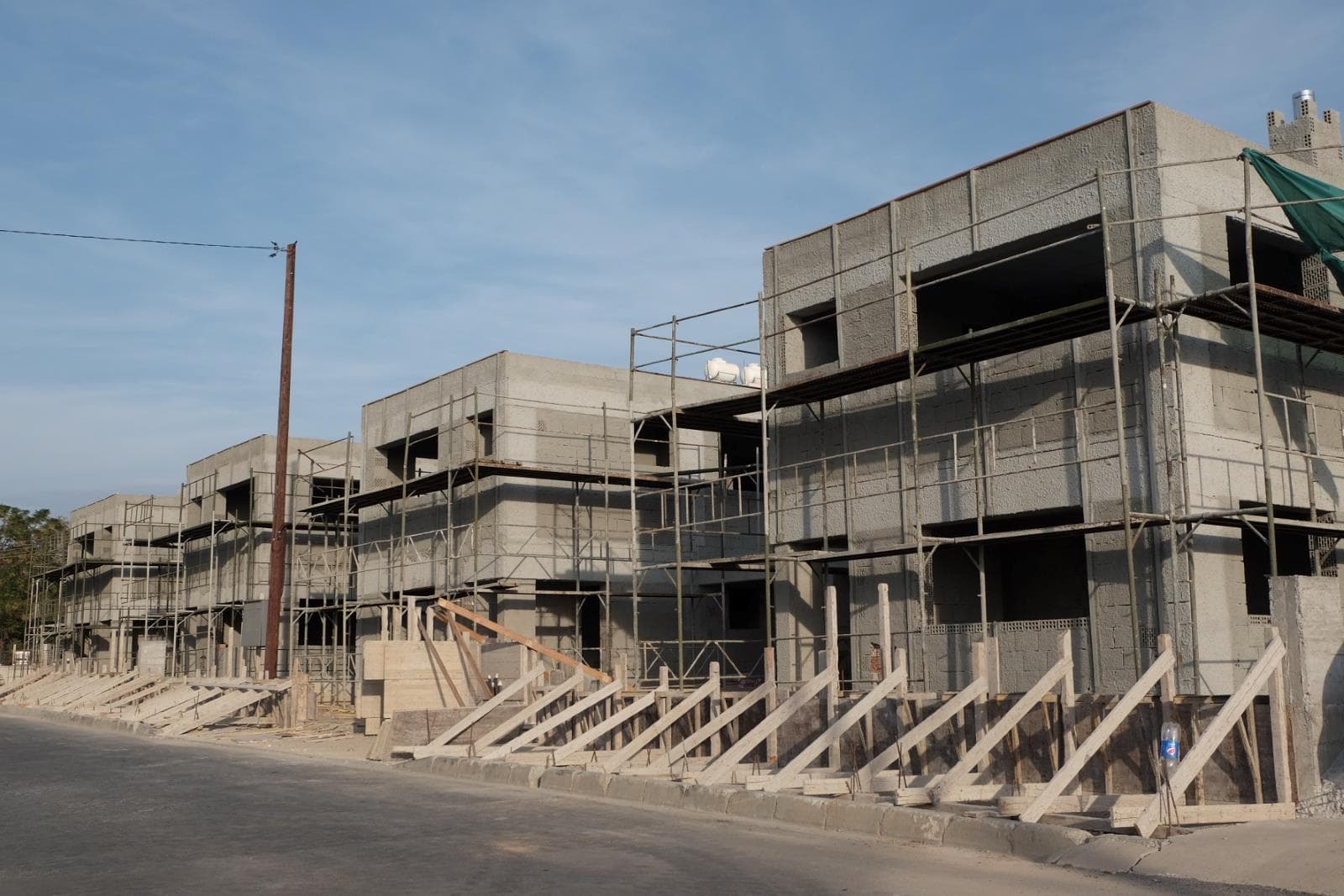
The photograph at the top of this article is one of our own sites, and the white boxes you can see on the roofs above the scaffolding are the water tanks going in before the render does. They are the least photogenic thing we install and nobody has ever asked us about them at a viewing. We would quite like that to change, and we suspect the winter of 2026 was the closest Cyprus has come in a century to making it change. Then it rained, and everyone moved on.
Ask us about the boring parts.
Tank capacity, drainage runs, irrigation zones and what the summer bills actually look like. We will give you the numbers on any home we build, in writing, before you commit to anything.