The Permit Queue A 100-Day Plan and the Number Nobody Has
A plan that begins by admitting nobody is counting
On 17 November the Cyprus Property Developers Association went to the Presidential Palace with a proposal for the housing permit backlog, and the first thing on the list is the one that should stop you. Before any target, before any deadline, before any reform of anything, the plan asks the authorities to spend thirty days counting how many residential applications are actually sitting there.
Read that again. The industry’s own fix for the permit queue opens with a request that somebody find out how long the queue is. That is not a criticism of the association, whose president Yiannis Misirlis put the plan to President Christodoulides with Interior Minister Constantinos Ioannou in the room. It is the most honest thing in the document. We went looking for a published figure while writing this article. There is no national number for pending residential planning applications. There is no published average wait. There is no district breakdown. We build in Paphos and we cannot tell you today how many files are ahead of ours, and neither can anyone else.
Everything else in this article follows from that absence, so it is worth sitting with it for a moment before we get to the rest of the plan.
What was actually put on the table
The proposal is a hundred-day programme with two hard milestones and a governance structure around them.
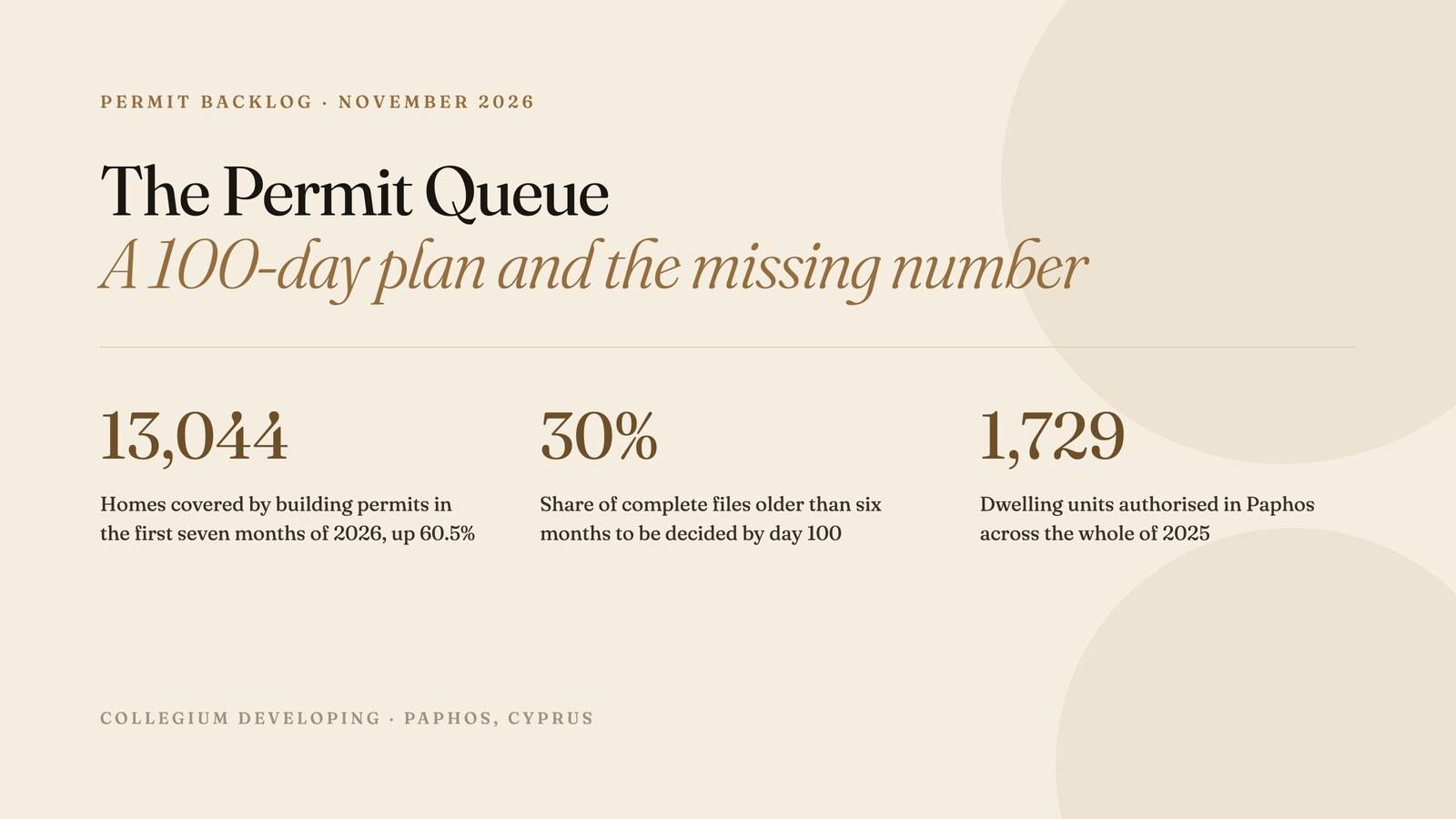
Within the first thirty days, every outstanding residential application gets recorded. By day one hundred, the authorities issue final decisions on at least thirty per cent of the complete applications that had already been waiting longer than six months when the clock started, and every decision has to carry its reasons. A minister and a named coordinator take charge of delivery, the Presidency monitors progress, and the numbers get published every month.
Around that sit four supporting asks. Binding deadlines for the District Local Government Organisations and the other licensing agencies. Consultations between agencies run in parallel rather than one after another. Extra staff where the files prove there is a shortage. And improvements to Ippodamos, the online platform through which planning and building applications now pass.
Alongside the permit plan the association raised labour shortages, a set of costed financing and tax proposals, the release of state land for housing, and a standing assessment of housing need with measurable annual targets. All of that was presented as a request for the President’s backing. None of it is government policy as of today, and it is worth being precise about that, because the gap between a proposal presented at the Palace and a circular that reaches a planning officer in Paphos is usually measured in years.
Thirty per cent of the complete ones
The headline target has two qualifiers in it and both of them do a great deal of work.
The first is “thirty per cent”. On a queue of files already past six months, deciding three in ten within a hundred days leaves seven in ten exactly where they were. We understand why the number is modest. A target that gets hit is worth more than one that gets quietly dropped in February, and the association is clearly trying to design something the civil service can actually deliver. But it should be read for what it is, which is a demonstration that the machine can be made to move, not a clearance of the backlog.
The second qualifier is the one that decides whether the whole thing works. “Complete” applications. In Cypriot planning practice, an application is not a thing that sits in a queue waiting its turn. It is a thing that gets examined, found to be missing a document or a clarification or a consultation response, and sent back. When it comes back in, it is a new file in every practical sense. Anybody who has built here knows this cycle and has learned to expect two or three rounds of it on a scheme of any size.
So if you set a target that applies only to complete applications, you have handed the authority a lever it did not previously need to think about. The cheapest way to hit a completeness-gated target is to be stricter about completeness. We are not suggesting anyone would do that deliberately. We are saying that targets shape behaviour, that this particular target has an obvious soft spot, and that the monthly published numbers need to show the returns as well as the decisions or they will tell you nothing at all.
If you want to understand how that cycle plays out on an ordinary villa, we set out the full sequence from plot to permit in our guide to building a house in Cyprus.
The fast track already solved the easy half
Here is the part of the picture that rarely makes it into the headlines, and it matters because it tells you where the queue really is.
Since October 2024 there has been a fast-track route for low-risk development, meaning one or two dwelling units. Planning permit and building permit together inside forty working days, roughly twenty working days a stage, with the designer signing a checklist and taking responsibility for compliance. From 31 March 2025 a second tier covered medium-risk schemes, up to twelve terraced houses or a block of up to twenty flats, in eighty working days.
In his budget presentation this month the Interior Minister put numbers on it. Around three thousand permits for developments of one or two homes issued inside forty working days. More than one thousand four hundred permits for blocks of up to twenty flats inside eighty days. Those are not small figures and we are not going to pretend otherwise. For a private client putting up a single house on a clean plot in a straightforward zone, the system in 2026 works roughly as advertised, and that was not true three years ago.
Which raises the obvious question. If the small schemes are moving and the medium ones have their own route, what exactly is in the queue the association went to the Palace about?
Our answer, from the inside: everything that does not fit the checklist. Schemes above the medium-risk ceiling. Plots that need a consultation response from a third body, which in practice means the Water Development Department, the Electricity Authority, the Department of Environment, Antiquities, or the Forestry Department depending on where you are. Anything touching a coastal protection zone. Anything in a village where the Local Plan is mid-revision. Anything with a boundary question the Land Registry has to settle first. And the applications that fell out of the fast track partway through because a checklist item turned out to be arguable.
The fast track did not shorten those. It took the simple files out of the pile and left a residue that is, by definition, made up of the hard ones. That residue is now the whole problem, and a thirty-per-cent target on complete files is a blunt instrument for it.
What 13,044 homes does to a planning office
The backlog did not appear because the service got worse. It appeared because the pipeline roughly doubled.
Building permits issued in the first seven months of 2026 covered 13,044 homes, which is 60.5 per cent more than the same period a year earlier, with 9,298 of those homes in residential blocks of flats. That figure comes from the statistical service and it is the single most important number in this story. A planning department staffed for one volume of work received something close to double it, in a year in which the local government reform had already moved the function into the new District Local Government Organisations and those organisations were still finding their feet.
Larnaca’s organisation has been unusually candid about the result. It granted 2,162 planning permits in 2026 against 1,759 in 2025 and 597 in the second half of 2024, so output has genuinely risen, and it attributes the delays that remain to three things: long-standing procedure, the sheer volume of files, and the Ippodamos system, which it says has improved but has still not become a modern digital tool capable of quick and efficient processing. That is a licensing authority saying publicly that its own software is part of the problem. We have no reason to think Paphos is different.
The flats number deserves a second look too. Nearly three quarters of the homes permitted this year are in apartment blocks, which is a structural shift in what Cyprus is building, and it brings a different set of obligations with it. If you are buying into one of those blocks, the rules on how it is run afterwards changed this year as well, and we covered them in our guide to jointly owned buildings in Cyprus.
Paphos is the smallest pipeline and that has not made it quick
Across the whole of 2025 Paphos district saw around 1,729 dwelling units authorised. Nicosia had 5,374, about a third of the national total. Limassol had 4,745 and Larnaca 3,778. Famagusta had 545. We are the second smallest district by permitted volume and not remotely close to the top three.
If the queue were purely a function of file volume, Paphos would be the quickest district in the country. It is not. Our experience over the past two years is that a straightforward Paphos file moves at about the national pace and a complicated one moves slower, and the reason is that the constraint is not the number of files. It is the number of people qualified to examine them and the number of external consultations each file triggers.
Paphos triggers a lot of consultations. We have more coastline per head of development than Nicosia, a density of registered archaeology that stops plots nobody expected it to stop, a countryside policy statement that bites on a large share of our plots, and a water position that has made the Water Development Department a far more active participant in planning than it was, as we wrote when we looked at the water shortage and what it means for new build. A district with a small pipeline and a high consultation rate does not benefit much from a plan aimed at throughput.
The Paphos Local Plan is also mid-revision, which is its own source of friction. We explained what the zones currently allow and what the review could change in our piece on planning zones in Paphos, and it is worth reading alongside this one, because a file whose zone is about to change is a file nobody wants to be the one to decide.
Ippodamos is doing more work than anyone admits
The plan asks for “improvements to Ippodamos” and that is the vaguest line in it. We would like to see it made specific, because the platform is now the only place the state can see its own queue.
Every planning and building application in Cyprus passes through Ippodamos. That means the thirty-day count the plan opens with is, in principle, a database query. The reason it would take thirty days rather than thirty minutes is that the data in there is not structured to answer the question. There is no reliable flag for when a file was first submitted as distinct from when it was last resubmitted, which is exactly the distinction that would reveal how long applicants are really waiting. There is no clean way to separate time the authority held the file from time the applicant held it. Those two things are not an IT detail. They are the whole argument about whose fault the delay is, and the system currently lets both sides claim the other one is responsible.
Our view is simple. If one change were made to Ippodamos and nothing else in the plan happened at all, it should be this: record a permanent first-submission date on every file, record every return to the applicant and every resubmission against it, and publish per district, every month, the median elapsed time from first submission to final decision, with the authority-held and applicant-held portions shown separately. That is a reporting change, not a rewrite. It would cost a fraction of what an extra planning officer costs. And it would end the argument permanently, which is probably why it has not happened.
Binding deadlines without staff are a trap
The ask for binding deadlines on the District Local Government Organisations is the item we are most uneasy about, and we want to be careful here because we understand why the industry wants it.
A deadline with no consequence is a suggestion. A deadline with a consequence, attached to an office that is short of examiners, has three possible outcomes and only one of them is good. The office hires and the files move, which is what everyone wants. Or the office refuses more applications, because a refusal is a decision and it stops the clock. Or the office becomes aggressive about completeness and the files never enter the clock in the first place. The plan does contain the ask for extra staff, and the two items belong together, but they were presented as separate bullets and in our experience the deadline is the one that survives contact with a budget process.
There is a version of this that works and it is the parallel consultation item, which got the least attention of anything in the proposal and is probably the single highest-value change on the list. At the moment a file that needs three external opinions frequently collects them in sequence, because each body wants to see the previous response. Three sequential six-week consultations is four and a half months of calendar time in which no planning officer is doing anything at all. Run them concurrently and you take months off a hard file without hiring a single person or setting a single deadline. That is the reform we would spend the political capital on.
A permit is not a home
One more thing needs saying about the 13,044 figure, because it is about to be used in a way that will mislead people.
A building permit is permission to start. It is not a completed home, it is not a connected home, and in the current market it is not even reliably a home that will be started this year. Between permit and keys sit the construction period, the inspection regime, the certificate of final approval, and the utility connections. We have watched finished buildings in Paphos stand empty and dark waiting for the Electricity Authority, which we wrote about at length in why EAC connections are holding up new homes, and the inspection side has its own queue, covered in our piece on who actually checks your new home.
Clear the permit queue and you move the bottleneck. You do not remove it. A hundred-day plan that delivers decisions on three in ten old files will push a wave of starts into a construction market already short of labour, onto a grid already struggling to connect what is finished, through an inspection regime that is being rebuilt while it runs. The association did raise labour shortages at the same meeting, to their credit. We would go further and say the permit queue, the connection queue and the labour shortage are one problem with three symptoms, and treating the first in isolation produces a very satisfying statistic and a slightly worse outcome.
What this means if you are building right now
Nothing in the proposal changes your position today. It is a request, not a rule. But there are things worth doing while it is being considered, and most of them are about making your file unambiguously complete before it goes anywhere near the counter.
Find out early whether your plot qualifies for the fast track. One or two units on a clean plot in a defined zone is a different animal from everything else and the forty-working-day route is real. If your scheme sits just above a threshold, it is worth modelling what happens if you drop below it, because the difference between twelve units and thirteen can be the difference between eighty working days and an open-ended wait.
Identify every external consultation your plot will trigger before you submit, not after the first return. Coastal setback, archaeology, forestry boundary, water supply, environmental screening. Each one is weeks and they are knowable from the plot and the zone. A consultant who tells you this in week one is worth several times one who discovers it in month five.
Keep your own clock. Record the date of first submission, every return, what was asked for, and the date of every resubmission. If the monthly published figures the plan asks for ever arrive, you want your own record to check them against. If they do not arrive, your record is the only evidence you will have.
And if you are buying off plan from a developer who is quoting you a completion date, ask which permits are actually in hand. Not applied for. In hand. We set out the questions worth asking in our guide to buying off plan in Paphos, and in a year when permitted volume is up sixty per cent they matter more than usual, because a great many of those 13,044 homes are being sold on the strength of a permit that only just arrived.
Our position
We think the plan is worth backing and we think it is aimed slightly to the left of the target.
The thirty-day count is the best idea in it and deserves to be treated as the main event rather than the preamble. A state that does not know the length of its own queue cannot manage it, cannot budget for it, and cannot be held to account over it, and the fact that the industry had to ask for the count tells you more about the past decade of planning administration than any individual delay does. Do that one thing properly, publish it per district every month with the applicant-held and authority-held time separated, and a good deal of the rest becomes self-correcting, because no district wants to be bottom of a published table.
The thirty-per-cent target we would raise, or rather we would change its shape. Three in ten of the oldest complete files is a throughput measure, and throughput is not what is hurting people. What hurts is variance. A developer can plan around a nine-month permit. Nobody can plan around a permit that takes between four months and three years depending on which officer picks it up and whether a consultation body replies. We would rather see a target on the tail, something like no complete residential file older than twenty-four months by day one hundred, than a percentage of the middle.
And we would stop pretending the ordinary queue and the deviation queue are separate systems. The Audit Office found individual deviation cases running to eleven years, and the people examining those files are drawn from the same small pool of qualified planners who are supposed to be clearing ordinary applications. We wrote about the deviation reform last week in our piece on planning by exception, and the connection to this one is direct. Every hour spent on an exception to the plan is an hour not spent on an application that complies with it. Fix the Local Plan so fewer people need the exception, and the ordinary queue gets shorter without anyone setting a target at all.
We build inside the zone, we submit complete files, and we still wait. We would take the count over the target any day.
This article describes a proposal presented to the President on 17 November 2026 by the Cyprus Property Developers Association and public reporting available in late November 2026, principally the Cyprus Mail and SigmaLive accounts of that meeting of 17 and 18 November 2026, the Interior Ministry budget figures presented the same month, Cyprus Statistical Service building permit releases for 2025 and 2026, published statements by the Larnaca District Local Government Organisation, and Audit Office special report EE-EY 30/2026. The 100-day plan is an industry proposal and not government policy, and nothing in it has been adopted at the time of writing. Figures quoted here are as reported rather than official where noted. This is not legal or planning advice. Confirm the current position for your own application with the Department of Town Planning and Housing and the Paphos District Local Government Organisation.
Waiting on a permit and nobody will tell you how long?
Send us the plot and what you have submitted, and we will tell you which route your scheme should be on, which external consultations it is going to trigger, and what we would expect the realistic wait to be in Paphos today. No obligation and no sales pitch.